Faith, Silence, and Artistic Labor in Tarkovsky's Andrei Rublev
What does it mean to make art in an absurd and cruel world?
The question has a half-life that outlasts most answers. Whether anything one makes persists against the substrate of violence and forgetting. Whether the act of creation is naive, or arrogant, or simply orthogonal to the real texture of human experience. Tarkovsky’s film does not settle this. It shows you someone living inside the problem for three hours, and by the end the terms have shifted in ways that resist summary.
Fifteenth-century Rus’ is not a nation. It is a lattice of principalities still hemorrhaging from Mongol conquest, governed by princes whose energies split roughly evenly between fratricidal war and the nominal defense of borders that exist mostly on parchment. Tatar raids are cyclical, almost meteorological. Villages burn and are rebuilt on the same charred foundations, burn again. The church functions as the sole institution with any transregional coherence, the only thing resembling continuity across the penumbra of devestated territories, and even it is fractured by schism and political instrumentalization.1 The mud in Tarkovsky’s Rus’ has a particular quality, thick and sucking and omnipresent, the kind of mud that swallows hoofprints and boot leather and entire seasons, that coats the hems of cassocks and the faces of children and dries on everything like a second grey skin. Rain falls sideways into open doors. icons stare from church walls with flat gold eyes that have witnessed everything and forgotten nothing and learned nothing from any of it.
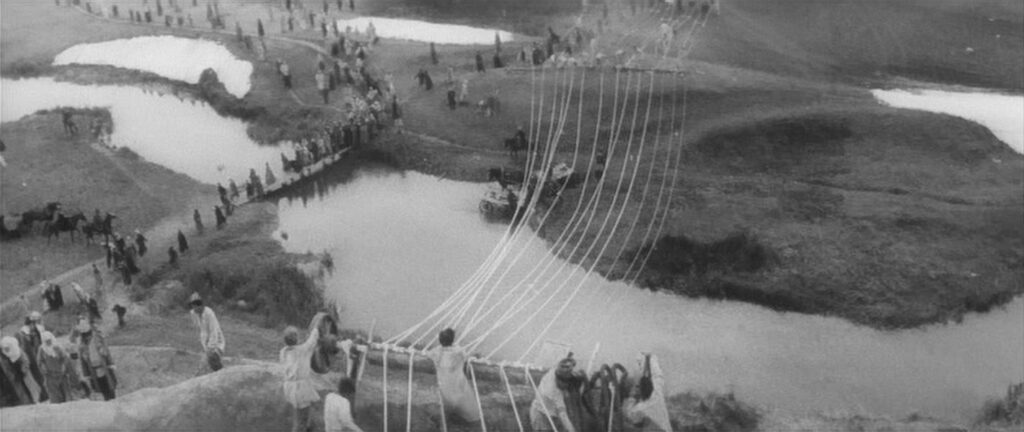
In the film’s first sequence, a man constructs a crude hot air balloon from animal skins stitched together with gut thread, rises above his village while the ropes snap taut and the frame groans, glimpses the curvature of the world from an altitude no one in his century was meant to reach, the fields and rivers and the dark line of forest spreading beneath him like something whispered by God, and then the wind shifts, and the contraption folds, and he falls. The camera watches him hit the earth the way it watches everything in this film: with patience that borders on cruelty. A horse grazes nearby. The balloon skin deflates across the grass like a thing exhaling its last. No one remembers him. No record, no name, no footnote in any chronicle of Muscovy. He saw the shape of the world from above and then the world took him back.
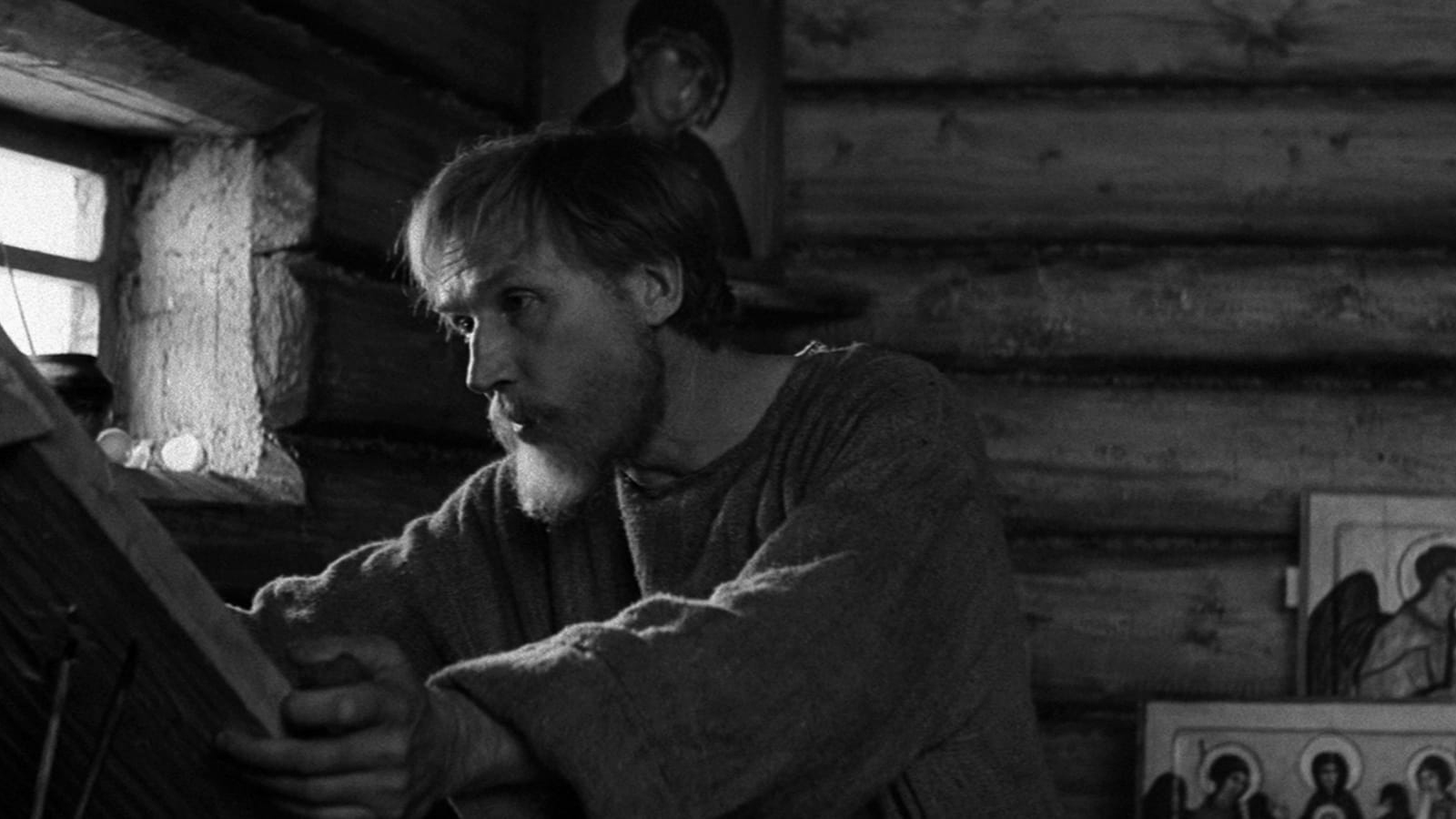
Andrei Rublev is a monk and icon painter. Tarkovsky follows him for two and a half hours as he moves through this landscape of interstitial catastrophe: taking commissions, debating theology with other monks, witnessing. A pagan festival in the birch woods, bodies in firelight, the smell of it you can almost. A jester arrested for mocking the boyars, dragged off while his audience scatters.2 Italian craftsmen hired to decorate a cathedral, their technical sophistication a quiet indictment of local capacity. The world presses in with accumulating weight, and the question sharpens: why paint transcendence when existence is this?
Then comes the raid.
Tatars and a treasonous Russian prince sack a cathedral city.3 The sequence is not something you watch so much as something that happens to you. A horse stumbling down stone stairs, legs buckling at angles that make your own knees flinch. The slick wet sound of metal finding bodies. Smoke uncoiling through the nave like a living thing, curling around pillars tasting the frescoes. A woman’s assault filmed with the cold patience of a witness who cannot intervene, the camera steady as a held breath, as a nail being driven. The cathedral fills with the particular silence that follows screaming, the silence that is not absence of sound but its negative image. Andrei kills a man to save someone. The axe comes down and something in the film’s moral architecture fractures along a seam you didn’t know was load-bearing. Afterward, he stops speaking. He stops painting. He takes a vow of silence that lasts years.
His silence is not dramatic. It is, you could say (and here the film almost says it for you, in the way his face empties out like water leaving a basin), the only coherent response to what he has seen. Almost thermodynamic. He watched what humans do to each other inside consecrated walls. The icons he painted depicted a world of grace and order, gold-ground figures suspended in theological certitude. The world he witnessed was mud and screaming and fire, the icons were about the world but they were not about this world, and the distance between the two doesn’t narrow, it collapses, the floor gives way. Any response feels inadequate. so he stops responding.
The impulse to go quiet makes sense. To stop making things because making things feels like a lie, or a distraction, or an insult to the actual temperature of events. What is the point of beauty when everything is burning? What is the point of form when the world is formless? A fair question. Possibly unanswerable, which is not the same as rhetorical.
Years pass. A boy named Boriska claims he knows the secret to casting bells. His father, a master bell-maker, has just died of plague, taking the craft with him, the boy insists, except for what was passed down. The Grand Prince needs a bell. The boy gets the commission.
He doesn’t know anything.
For forty minutes of screen time, we watch him bluff. he orders men around with the febrile authority of someone who knows that hesitation is fatal, no not authority, performance of authority, which is maybe all authority ever is. Rejects casting sites. Demands specific clay from a riverbank, gray-blue alluvial stuff he tests between his fingers with a connoisseur’s frown, rolling it, smelling it, like he’s tasting wine when really he’s tasting his own survival. The workers doubt him, and you can see it in their postures, the way they handle tools with conspicuous independence. He doubles down. When the furnaces are built wrong he rages, his voice cracking, a teenager’s voice, a voice that hasn’t decided what it is yet.4 The whole time you’re watching a boy improvise his way through a process that could get him executed if it fails, the clay drying in the molds, the charcoal smoke stinging everyone’s eyes, the molten bronze moving like something alive and hostile, and the furnaces glow like wounds in the earth, and the men’s faces in the firelight look like icons of themselves, and you think maybe this is what all making is, this terror, this.
The bell is cast. The mold is broken open. They hoist it, and for a long unbearable moment the clapper hangs motionless inside the bronze like a stopped heart. Everyone waits. The Grand Prince waits. Boriska waits, and you can see him not breathing, his whole compressed life balanced on this single point of silence. Then the clapper swings, and what comes out of the bell is not a sound exactly but a pressure, a low bronze voice that rolls across the field and pushes against your ribs, that hums in the mud and the timber scaffolding and the bones of every person standing there, a sound that has traveled six hundred years to reach this theater, this room where you are sitting, and it does not stop, it rings and rings and opens outward like something that was always there waiting to be released.
The boy collapses in the mud, sobbing, and confesses to Andrei: his father never told him anything.
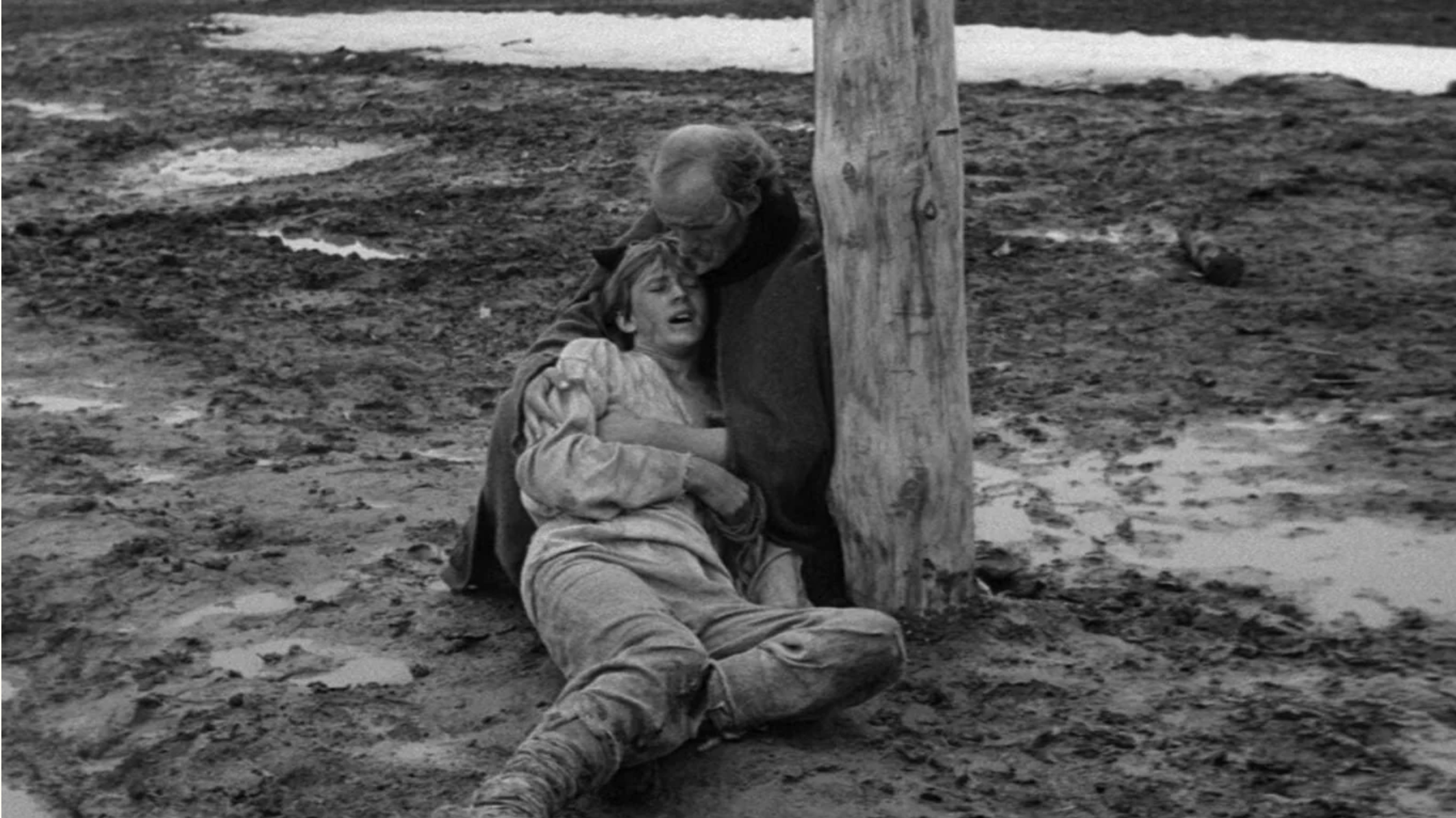
What matters here is not the confession but what preceded it.
Boriska had no inheritance, no technique, no guarantee. He had a commission he lied his way into and the threat of death if he failed. What he had was the willingness to act anyway: to dig clay with his own hands until his fingers bled and the riverbank looked like something had clawed its way out of it, to build furnaces from river stone, to stand in front of men twice his age and insist he knew what he was doing when he didn’t. The gap between knowledge and action which paralyzes most people, he simply walked across. Or fell across. The distinction may not matter.
The bell works not because Boriska had secret knowledge, and not because God intervened. It works because he did something. Creation happened in the mud, under threat, without certainty. The material world cooperated with his desperation, or it didn’t refuse it, which might be the same thing.
Waiting to know enough, waiting to feel ready, waiting for conditions to settle into something legible, for the chaos to resolve, for things to make sense first. The bell doesn’t care about any of that. It rings or it doesn’t. You find out after.
Andrei watches the boy collapse and weep and confess his fraud, and something breaks open in him. He speaks for the first time in years. He decides to paint again. Not because the world has improved. Not because the violence has been explained or redeemed. Because the boy’s act of making, performed in ignorance and terror, reconstitutes the possiblity of making as such. Because someone reached into the furnace and the furnace, for once, gives something back.
The bell doesn’t undo the raid. The icons Andrei will paint won’t resurrect the dead. But the act of creation, of imposing form on chaos, of ringing out across a ruined landscape, is itself the point. Meaning isn’t something you find before you begin. It emerges from beginning.
The film ends in color. For two and a half hours, we have watched a world rendered in brown and grey and black: mud, smoke, rain, blood, the undifferentiated pigment of suffering. Then Tarkovsky cuts to Rublev’s actual icons, and.
The screen doesn’t explode. That’s wrong. It’s more like the screen remembers something it had been withholding, the way a fever breaks, the way a room fills with light when you pull back curtains you forgot were there. Gold leaf catches light as though the surface were breathing, as though six centuries were a single held breath finally released. Deep lazurite blue, ground from Afghan lapis carried along trade routes that no longer exist, suspended in egg tempera by hands that have been dust for half a millennium, and the blue is still wet-looking, still saturated, still that particular shade of impossible that sits behind your eyes after you close them. The famous Trinity, three angels at Abraham’s table, their robes falling in folds that seem to move with a patience the film’s human figures never achieved, a patience that belongs to pigment and wood and the slow chemistry of survival.5 The camera drifts across cracked and luminous surfaces, across paint applied by a hand we have just watched go still and then (this is the thing, this is what the whole film has been building toward and you didn’t know it until now) return to work.
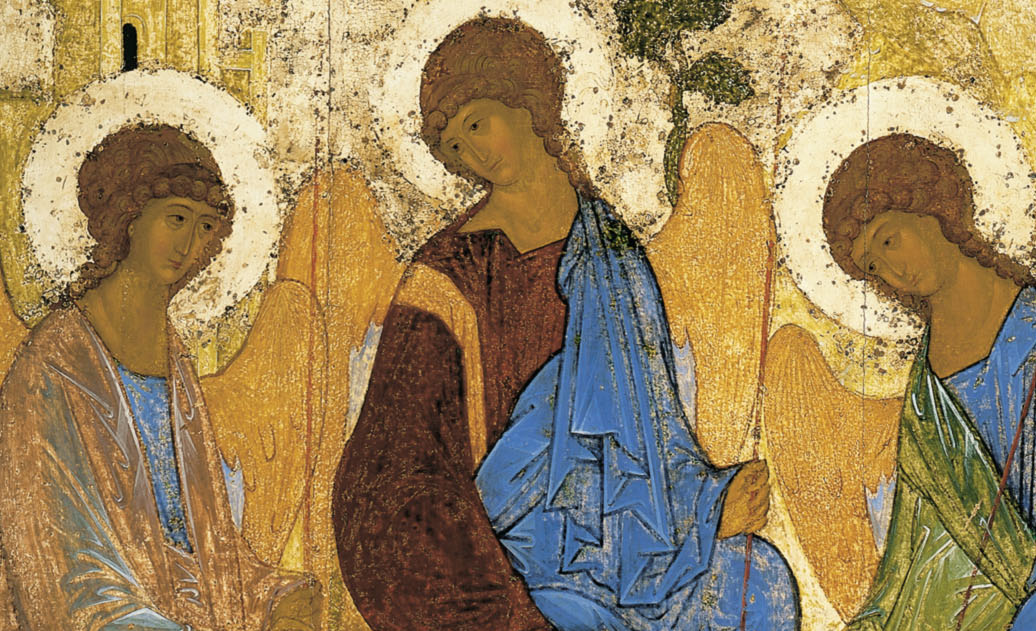
The world that produced these images was brutal and chaotic and largely forgotten. the images remain, not because they fixed anything, they fixed nothing, but because someone made them anyway. The substrate dissolved. The icons persisted. This is not a consolation exactly, but it is a fact, and maybe facts are what’s left when consolation runs out.
Whether making things matters isn’t something the film settles. But it suggests something. That the question might be wrong. That waiting for certainty is its own kind of silence, and silence, as Rublev discovered, can become indistinguishable from abdication. That the bell rings or it doesn’t, and you won’t know until you cast it.
Boriska didn’t know what he was doing. He did it anyway. And six hundred years later, Rublev’s icons still hang in museums, still glow with that impossible gold, made by a man who once went silent and then decided to speak again.
Maybe that’s enough. maybe it has to be.
Footnotes
-
The political geography of Rus’ in this period resists tidy summary. After the Mongol invasions of the 1230s-40s, the region splintered into dozens of principalities paying tribute to the Golden Horde while competing for the khan’s favor and each other’s territory. Janet Martin’s Medieval Russia, 980-1584 (Cambridge UP, 2007) maps this fragmentation in useful detail, though even she acknowledges the source base is thin enough to make confident claims difficult. Tarkovsky compresses a century of this into atmosphere. The mud alone does half the work of historiography. ↩
-
The jester, or skomorokh, belongs to a tradition of itinerant performers that the Orthodox Church spent centuries trying to suppress, with mixed results. Robert Bird’s Andrei Rublev (BFI Film Classics, 2004) reads the arrest scene as Tarkovsky’s oblique commentary on Soviet censorship, which is probably right but also maybe too neat. The scene works without the allegory. Most good scenes do. ↩
-
The raid sequence draws on the 1408 sack of Vladimir by Khan Edigei’s forces, though Tarkovsky folds in details from other attacks and invents freely. His screenplay notes, published in Collected Screenplays (Faber, 1999), suggest he was less interested in historical fidelity than in the phenomenology of violence as experienced from inside a church. Which is a very Tarkovsky sentence to write, and I apologize for it, but there it is. ↩
-
Medieval bell-casting was genuinely dangerous and genuinely secretive, a guild craft with closely held techniques for alloy ratios and mold construction. Whether a teenager could bluff his way through it is, charitably, implausible. Tarkovsky apparently consulted with metallurgists during production and decided the implausibility was the point. I once tried to explain this scene to someone at a party and ended up just describing a boy crying in mud for ten minutes. It did not go well. ↩
-
Rublev’s Trinity (c. 1410-1427) survived because the Trinity Lavra of St. Sergius preserved it through centuries of political upheaval, sometimes under layers of later overpainting. It was cleaned and restored in 1904 and hung in the Tretyakov Gallery in Moscow until 2023, when it was transferred to the Trinity Cathedral. The lazurite blue in the central angel’s robe is among the most analyzed pigments in Russian art history. Six hundred years and it still looks wet. ↩