Unreliable Narration as Historical Method in Jiang Wen's In the Heat of the Sun
The film opens on a Beijing summer in the 1970s, deep in the Cultural Revolution. A teenage boy named Ma Xiaojun runs feral through depopulated streets with his friends. Their parents have been absorbed into political campaigns, swallowed by the machinery of denunciation and collective self-criticism. The city has become a vast unsupervised substrate, every rooftop and alleyway theirs. Gu Changwei’s cinematography saturates the frame in amber and honey, a warmth so total it feels less like sunlight than like the residue of want, like someone poured the whole decade through a filter of longing until the light itself became a confession.1 Nothing photographed in the present tense looks like this. This is light remembered, not light received. The kind of warmth that only exists after the thing it illuminated has already gone cold.
There’s a girl, Milan. Older, beautiful, irretrievably out of reach. Ma Xiaojun breaks into her apartment when she’s not home and lies on her bed. He steals her photograph. He inserts himself into her life by sheer gravitational insistence. She may or may not notice him. The film stays hazy on this, deliberately so, the boundary between what happened and what was willed into happening left unmarked, because for Ma Xiaojun the distinction dissolved long ago, the wanting and the having fused together under enough pressure and enough years until. Every scene has the texture of something polished by decades of longing, the inconvenient grain buffed away.
Two hours later, near the end, Ma Xiaojun confesses: “I made it all up.”2
Not apologetically. Not as revelation. He says it the way you’d say the sky is blue, or the way you’d admit to something everyone in the room already suspected but was too polite to name. The whole architecture of the summer collapses. or doesn’t. The confession lands less as shock than as confirmation of something the film has been whispering the entire time, in the too-perfect light, in the way Milan always turns toward camera at exactly the right moment, in the suspicious coherence of every anecdote.
The cells in your body replace themselves. Your brain rewires its own circuitry. The person who lived through your childhood is connected to you by an unbroken chain of days, but that’s the extent of it. You share a name. You share a body, sort of. You share memories.
Except you don’t, really. You share the memories you’ve kept, the ones you’ve rehearsed and revised and selected for retention, the ones that survived not because they were truest but because they were (useful? flattering? load-bearing?) and the others are gone, decayed past the threshold of recall. The person who lived them is gone too, in every way that matters except the story you’ve assembled from the wreckage.
Ma Xiaojun understands this. Or rather, the film understands it about him. The summer he shows us isn’t recovered from some archival substrate. it’s authored. Composed, scored, lit like a fever dream, like something that needed to be beautiful because the alternative was admitting it was just a summer, just a city, just a girl who probably didn’t.
Memory isn’t a recording. What stays with me about the film is how viscerally it makes this felt rather than argued. Every time you remember something, you’re reconstructing it from fragments, the brain filling lacunae with plausible details, stitching continuity from scattered signals the way a river deposits silt into shapes that look deliberate but aren’t. Each recall is a new act of creation. The memory of the memory replaces the memory of the event, and so on, and what you’re left holding is the most recent reconstruction, a palimpsest where the original text has been scraped away so thoroughly that the scraping is itself invisible, and you’d swear the surface was always this smooth.3
The corollary is counterintuitive and brutal: the things you remember most vividly are often the least faithful. You’ve handled them too many times. They’ve been worn smooth by repetition, polished into the version that fits the self you need to be. The memories you never revisit might be closer to what occurred, but they’re also fading, half-gone, disappearing into the penumbra of everything you didn’t bother to keep.
Ma Xiaojun has thought about Milan for decades. He’s rehearsed the story of that summer so many times that the story is all that remains. The film makes this visible at the level of the image itself. The golden light isn’t how Beijing looked. It’s how he needed it to look. Milan in slow motion, backlit, turning toward him with impossible deliberateness, her face resolving from blur into focus like a photograph developing in chemical solution, the emulsion still wet. That’s not memory. That’s desire fossilized into fact, the wanting compressed under so many layers of retelling that it hardened into something you could hold, could point to, could say this happened about.
The most vivid memories, the ones that feel solid, granular, true. Those are exactly the ones most revised without anyone noticing.
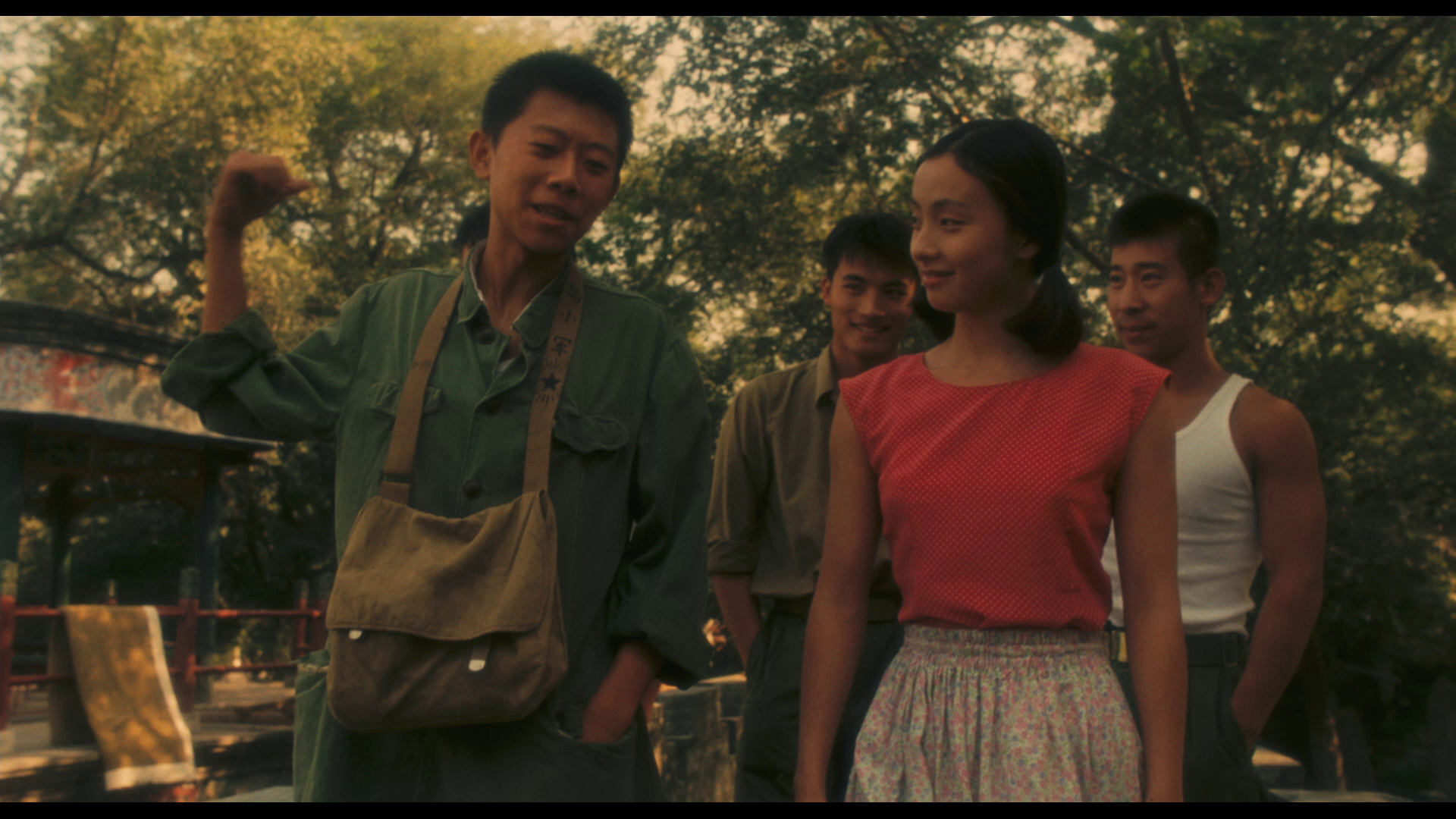
The Cultural Revolution is the film’s structural precondition, though it barely appears directly. The parents have been absorbed into struggle sessions and denunciations, building their own mythologies of political consciousness. No one is watching the children.4
This matters because there’s no one to contradict them. No witness to say “that’s not how it happened” or “you weren’t that brave” or “she didn’t look at you that way.” The kids are building their reality in real-time, collaboratively, and memory will rebuild it again later, each reconstruction a little more coherent, a little more flattering, a little further from whatever actually occurred. The interstitial space between experience and narrative shrinks to nothing.
Most of childhood works this way, not just in revolutionary Beijing. You’re too young to have reliable witnesses. Your parents remember a different version, focused on different details, and anyway they weren’t there for most of it. Your friends remember their own versions, centered on themselves. By the time you’re old enough to compare notes, the stories have already hardened into load-bearing mythology. You’ve built a self on top of it. To question the foundation is to threaten the structure.
What would it even mean to remember a childhood accurately? Accurate to what? The experience you had at the time, unmediated by language? The experience you constructed an hour afterward, when you first told someone, when the telling already selected and shaped? The experience you’ve reconstructed every time you’ve thought about it since, each iteration overwriting the last, until you can’t even locate the seam where the original ended and the reconstruction began because the reconstruction has been repairing its own seams for years?
What the film keeps pressing on is the question of selective authorship, and the degree to which it differs from lying. not much, maybe, in mechanism. Entirely, in valence.
Ma Xiaojun isn’t lying, exactly. He’s doing something more subtle and more universal. He’s chosen what to remember. He’s chosen what it means. He’s arranged the fragments into a narrative that explains who he became, a narrative whose explanatory power depends on its departures from the raw data.
The origin myths people tell about themselves. “I was always interested in X.” “That summer changed everything.” “I knew then that I wanted to Y.” These aren’t neutral reports. They’re selections. Out of the chaos of lived experience, certain moments get declared significant. Lines get drawn connecting them. A protagonist with an arc gets constructed, which is to say something happens that reality never does on its own. Everyone does this.
The moments not selected have faded, starved of rehearsal. They’re not part of the narrative, so they don’t get revisited, so they decay. The story becomes more true over time, not because it converges on what happened, but because what happened is disappearing while the story remains. Eventually the story is the only surviving record. It wins by default.
Ma Xiaojun needed to be the protagonist of that summer. He needed Milan to have seen him. He needed his courage to have been real. So when he reconstructed the past, he made it so. Not consciously. Not deceptively. Just inevitably, the way water finds the lowest point, or the way a sentence wants to resolve into. The alternative would be to carry a fragmented, incoherent, meaningless jumble of unprocessed sensory data. nobody can do that. Nobody should have to.
The stories told so many times they’ve smoothed into fact, the version of a childhood that makes sense, the moments selected to mean something, the connective tissue fabricated between them. How much was shaped to fit? How much was invented?
Unknowable. That’s the uncomfortable part.
The film doesn’t judge Ma Xiaojun. It treats his fabrication as inevitable, maybe necessary. The confession at the end isn’t a moment of shame. It’s almost a shrug. Of course he made it up. What else was he supposed to do with the raw, unnarratable chaos of having been young?
You can’t carry a fragmented past. You can’t walk around with unprocessed noise where your history should be. You have to make it into a story. And stories have protagonists, and arcs, and meaning. Stories have coherence. Life doesn’t, but the memory of life can, if you select carefully enough, if you’re willing to let the inconvenient parts fade into the lacunae where they’ll trouble no one.
There’s no authentic version hiding underneath. There’s just the version you’ve built, and the version you’re building now, and the version you’ll build next time you remember. Turtles all the way down, except the turtles are drafts and each one overwrites the last.
The fabricated summer shaped Ma Xiaojun. The golden light, the perfect girl, the brave version of himself. He became the person who had that summer, even though he didn’t have it. The memory was load-bearing. It held up a self that would have had no architecture without it.
The constructed versions aren’t corruptions of some purer truth. They’re the material a person is built from. Take them away and there’s nothing underneath, just fragments that never cohered, data that never became a self.
The final scene shows the grown characters in a limousine, nouveau riche in the new China. Money, status, the markers of having made it. The surface grammar of success.5
The color drains to black and white. Not gradually. Not artfully. It goes like heat leaving a body.
They don’t recognize each other. They don’t recognize themselves. The golden summer is so far away it might as well have happened to different people. Which, in the deepest sense, it did. And also didn’t. The continuity of identity and the discontinuity of self, held in the same shot, and the shot just sits there, refusing to explain itself.
Ma Xiaojun’s voiceover goes detached, almost clinical. The warmth is gone. Not replaced by cold exactly, but by something flatter, thinner, the temperature of hospital corridors and government documents, the temperature of a present tense that has no golden filter because no one has yet needed to mourn it. He looks at these middle-aged strangers and tries to connect them to the kids on the rooftops, the kids drenched in that amber light, and the connection won’t hold. The thread pulls and pulls and then there’s nothing at the other end.
Maybe they never knew each other. Maybe no one ever knows anyone. Maybe the versions we construct of other people are as fictional as the versions we construct of ourselves, and the space between any two people is just two competing fabrications, negotiating.
The film doesn’t offer a solution. just a recognition, which is worse, because recognitions don’t resolve.
We are the stories we tell about ourselves. The stories are not true, not in the way we usually mean true. But they’re not false either. They’re something else entirely. Functional. Structural. The scaffolding without which the self is just a pile of lumber.
Ma Xiaojun made up his golden summer. He confesses this, and then the film ends, and we’re left to wonder what we’ve made up about ourselves.
What did any of us make up? What are we making up right now, in the act of remembering? What version of a self gets constructed in the selecting of thoughts, the arranging into narrative, the making-cohere into something that looks like a person thinking?
Maybe it’s not a bad thing. Maybe it’s just what we do. the only thing we can do.
The truth is probably messier. Duller. Less golden. And anyway, it’s gone. All that remains is the story, and the story is still being written, still revising itself every time you look at it, and whether that makes it more true or less true is maybe not the right question, was maybe never the right question, and there might not be a right question, just the looking, just the ongoing draft.
Footnotes
-
Gu Changwei, who also shot Zhang Yimou’s To Live and Chen Kaige’s Farewell My Concubine, gives the entire film this impossibly saturated warmth. It’s become a cliche to call cinematography “painterly” but here the quality is more specific than that, closer to the way colors intensify in dreams, oversaturated because the dreaming mind is compensating for what it can’t actually resolve. Gu later said the look was designed to feel like “a photograph left in the sun too long.” Which is such a perfect description for what nostalgia does to images that I almost don’t believe he actually said it. The light bleaches out the detail but deepens the color, which is also, come to think of it, exactly what happens when you remember something too many times. The resolution drops but the saturation climbs. ↩
-
The film is adapted from Wang Shuo’s novella Dongwu Xiongmeng (Wild Beast, 1991), but Jiang Wen departed substantially from the source. Wang Shuo’s story is harder-edged, more cynical, less interested in the phenomenology of nostalgia. Jiang Wen softened the violence, amplified the romanticism, added the entire meta-narrative frame of unreliable confession. The novella is about disillusionment. The film is about the impossibility of recovering what you’re disillusioned with. Different projects entirely. Though there’s something funny about a film about fabricated memory being itself a fabrication of a fabrication, Jiang Wen’s false memory of Wang Shuo’s false memory of a youth that was probably already half-invented when it was happening. ↩
-
The neuroscience here has gotten remarkably precise, and also remarkably strange if you let it be strange. Karim Nader’s landmark study demonstrated that consolidated memories, when reactivated, enter a labile state requiring new protein synthesis to restabilize, which means (and this is the part that should make you feel seasick) the molecule holding your memory together has to dissolve before it can re-form. Nader, K., Schafe, G.E., & Le Doux, J.E., “Fear memories require protein synthesis in the amygdala for reconsolidation after retrieval,” Nature 406 (2000): 722-726. Elizabeth Loftus’s decades of false-memory research points in the same direction from the behavioral side. There is no “reading” a memory that doesn’t also “rewrite” it. Every act of recall is an edit. Your memories are Theseus’s ship except nobody even noticed the planks were being swapped. ↩
-
The “sent-down youth” generation, those born roughly 1947-1960, had their adolescence hollowed out by the Cultural Revolution. Schools closed. Parents disappeared into political campaigns or were themselves sent to the countryside. In Beijing specifically, the population of unsupervised teenagers was enormous, whole neighborhoods run by kids barely old enough to understand the ideology they were supposedly enacting. Ma Xiaojun’s freedom isn’t incidental to the story. It’s the atmospheric condition that makes the entire mythology possible. No supervision means no correction means no competing account means the memory hardens into whatever shape you need it to be. There’s an irony here about a revolution obsessed with ideological purity producing a generation with the most unchecked access to private mythmaking in modern Chinese history, but I’ll leave that where it is. ↩
-
In the Heat of the Sun (1994) was Jiang Wen’s directorial debut. He was already one of China’s biggest actors, coming off Red Sorghum and Hibiscus Town. The film won Best Actor at Venice for Xia Yu (who played young Ma Xiaojun) and was a massive commercial hit in China, then got tangled in censorship disputes that delayed wider release. Jiang Wen has directed only six features in thirty years since, each one stranger and more ambitious. The limousine scene apparently baffled Chinese censors, who couldn’t decide whether it was celebrating or mocking the new capitalist class. both, obviously. Also neither. The scene isn’t about capitalism. It’s about the color draining out. ↩