Unknown Pleasures and the Sound of a City Losing Its Nerve Endings
The band wanted to sound like a band. Martin Hannett wanted to sound like the space between the notes. What arrived in June 1979 was neither, or both, or something the argument between those two positions produced that neither could have made alone. The legend is that the band hated the record when they first heard it. The legend is probably true. Hannett had taken their live sound, which was loud and fast and angry in the way that Manchester punk bands in 1979 were loud and fast and angry, and he had. Pulled it apart. Put distance between the instruments. Recorded the drums in a bathroom, or a toilet, or an elevator shaft (the accounts vary and Hannett, who was not in the business of clarifying, is dead). Put the bass through effects chains that gave it a metallic resonance, something subterranean, a sound that seems to be arriving from underneath the song rather than inside it. And Curtis’s voice, which in the rehearsal room was one instrument among several, became the only thing left at the center. Everything else orbited.
Manchester in 1979. The city has been mentioned so many times in the retelling of this record that the mentioning has become its own kind of erasure, the word “Manchester” doing the work that actual description should do. So: a city where the cotton mills that had been the reason for the city’s existence were closing or had closed. A city where the Victorian infrastructure, built for an industrial economy that no longer existed, was too expensive to maintain and too monumental to demolish, so it just. Sat there. Empty buildings with the machine oil still in the floors. The Mancunian Way, an elevated motorway that cuts through the city center like a scar from a surgery that didn’t work, opened in 1967, already crumbling by the late seventies. Hulme Crescents, the brutalist housing estate that was supposed to solve the housing problem and instead became the housing problem, concrete decks too cold to walk on in winter, staircases that smelled of. You can read the architectural histories.
The sound of the record is the sound of that city, not because Hannett set out to document Manchester but because he was working in Strawberry Studios in Stockport with the materials available, and the materials included a drummer whose kit he disassembled and reassembled and processed until it sounded like impacts rather than rhythms, like things hitting other things in enclosed spaces. The snare on “She’s Lost Control” doesn’t sound like a snare drum. It sounds like a door slamming in a corridor one floor down. The space is in the record the way damp is in a wall, not added but structural, a property of the material itself.
Curtis’s epilepsy gets mentioned in every account because it is impossible not to mention and because the temptation to read the lyrics through the diagnosis is so strong that resisting it feels like an affectation. But the seizures didn’t start until after the first album was recorded. The lyrics on Unknown Pleasures are not about epilepsy. They are about the sensation of being in a body that is not entirely under your own governance, which is a broader condition than any single diagnosis, and which the production makes audible: the voice surrounded by sounds it did not ask for, the rhythm section operating on a logic the vocal line cannot quite predict, the synthesizer tones that Peter Hook insists nobody in the band played and that Hannett apparently triggered and processed from sources he did not disclose.1
“Disorder” opens with that drum pattern, the one that sounds like a mechanical process rather than a human performance (and Stephen Morris was a human, a very precise one, but Hannett’s processing turned his precision into something that read as machinic, which is a different quality). Curtis enters: “I’ve been waiting for a guide to come and take me by the hand.” A first line that is also a confession, stated without preamble, no verse to ease into, no establishing context. Someone waiting. Waiting is most of what the album is.
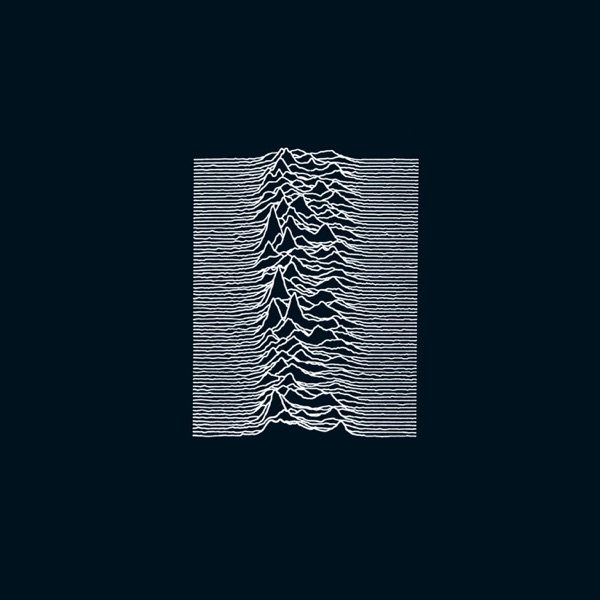
The pulsar image on the cover. Eighty successive pulses from radio source CP 1919, stacked vertically, taken from the Cambridge Encyclopaedia of Astronomy. Peter Saville’s design, or rather Peter Saville’s selection, because the image already existed and what Saville did was recognize that it was the right image, the image that was already the sound of the record before the record existed. A signal from a dead star. Regular, repeating, arriving from a source that has already undergone its catastrophe. The pulsar is still transmitting. The star it was is gone. The signal is what remains after the collapse, and the signal is beautiful, and the beauty is not redemptive, it is just the shape that energy takes when the thing producing it has already. The cover has been reproduced so many times on so many t-shirts that it has become wallpaper, and the wallpaper has become ironic, and the irony has become vintage, and underneath all of those layers the image is still doing the same thing it did in 1979, which is showing you what a signal looks like after the source has stopped being what it was.
Hook’s bass. The famous high-register bass, playing melodic lines in the range where most guitarists live, which in a conventional band would conflict with the vocals and in this band doesn’t because Hannett gave the bass and the voice different rooms. Hook is playing above Curtis. Curtis is singing from below the bass line. The inversion is the architecture of the record: everything is in the wrong register, everything is displaced from where genre convention says it should be, and the displacement is what makes the space, the particular emptiness at the center of each song where a normal rock record would put warmth and where this record puts. Distance. Air. The reverb on a snare drum recorded in a lift shaft.2
“New Dawn Fades” is four minutes of the band approaching something, the bassline climbing, the guitars building, Curtis’s voice gaining a momentum that sounds like either conviction or desperation (and whether those are distinguishable in this context), and then. It doesn’t arrive. It subsides. The thing the song was building toward turns out not to be a climax but a diminishment, the instruments pulling away one by one until only the bass remains, and then the bass stops, and there’s a few seconds of. The tape running. And then the next song starts as if nothing has.
Curtis hanged himself in May 1980, the night before the band was supposed to fly to America for their first US tour. The album had been out for eleven months. Everything that happened afterward (New Order, Factory Records becoming the most important independent label in England, the Hacienda, the entire culture of Manchester in the 1980s) happened because of and despite and around this fact.
The album does not know this. The album does not know what happens next. Listening to it with the knowledge of what happens next is a different experience from listening to it without that knowledge, and the second experience is no longer available to anyone, which means the album that was released in June 1979 no longer exists, has been replaced by a different album that carries the same sounds but different. The weight has shifted. “She’s Lost Control” is about a girl Curtis met at the employment exchange who had epileptic seizures, and it is about nothing else, and it is also about everything else, and the gap between those two readings is where the record lives now, which is not where it lived then.
Whether the record was always about this, or whether what happened made it about this retroactively, and whether there is a difference.
Footnotes
-
Hannett’s relationship to the band’s sound was essentially adversarial, in the productive sense. He wanted to make a record that sounded like how the music felt rather than how the music sounded, and the band wanted to make a record that sounded like the band. Both positions are defensible. Neither, alone, would have produced this record. The argument is the record. ↩
-
Hook developed the high-bass style because the rehearsal room was too loud and he couldn’t hear himself in the lower registers. A practical solution to an acoustic problem that became a defining sonic characteristic of an entire genre. Whether post-punk bass playing is, at its origin, a frequency-masking workaround rather than an aesthetic choice, and whether that distinction matters at all by the time the style has been reproduced across forty-five years of music, is a question that answers itself by not answering. ↩