Discontinuous Utility and the Jutland Paradox
On October 21st, 1904, the Russian Baltic Fleet fired on British fishing trawlers in the North Sea. Off Hull. They had mistaken the boats for Japanese torpedo craft, which, to be clear, would have required the Imperial Japanese Navy to teleport its destroyers twelve thousand miles from the Pacific into the grey chop of the English coast, but paranoia doesn’t check an atlas. Weeks at sea with bad intellegence and worse sleep and the whole fleet twitching at shadows, and then some unlucky fishermen hauling cod got raked with gunfire because a lookout saw what wasn’t there. One fisherman died. Britain nearly went to war with Russia over it. The trawlers had lanterns up.
The incident was a preview. That fleet, having dragged itself halfway around the world through tropical heat and coal shortages and a mutiny that never quite materialized, arrived at Tsushima the following spring already half-dead.1 What happened next took hours and felt like minutes. The Japanese crossed the Russian T, opened fire, and the thing just. Collapsed. Ship after ship burning or sinking or striking colors in water so full of wreckage the destroyers had trouble maneuvering for torpedo runs. the largest naval engagement since Trafalgar, and the outcome was settled before lunch. The Japanese lost three torpedo boats. The Russians lost their entire Pacific strategy, their standing as a European power, and the war itself.
Every admiralty in the world took notes. The British took more notes than most.
The problem with naval power before 1906 was that it was continuous.
You could rank every ship in the world on a spectrum. At the top sat the newest pre-dreadnought battleships: four heavy guns, perhaps a dozen secondaries, thick armor, moderate speed. Below them, older battleships with fewer guns or thinner belts. Below those, armored cruisers. Then protected cruisers. Then everything else, trailing off into the penumbra of gunboats and coastal monitors.
The gradient was smooth. A newer ship was better than an older ship, but not categoricaly different. A fleet with ten battleships could lose to a fleet with twelve. Naval strategy was arithmetic.
Admiral John “Jackie” Fisher had a different theory.
Fisher had watched Tsushima closely. The battle confirmed what he already suspected: long-range gunnery was the future. The Japanese had opened fire at ranges of eight thousand yards or more. At that distance, only the largest guns could hit anything. the intermediate guns that pre-dreadnoughts bristled with (the six-inchers, the nine-pounders) were useless. They complicated targeting, added weight, accomplished nothing.2
Fisher’s conclusion: stop building compromise ships. Build a ship with nothing but the biggest guns. More speed. More armor where it mattered. Accept no trade-offs.
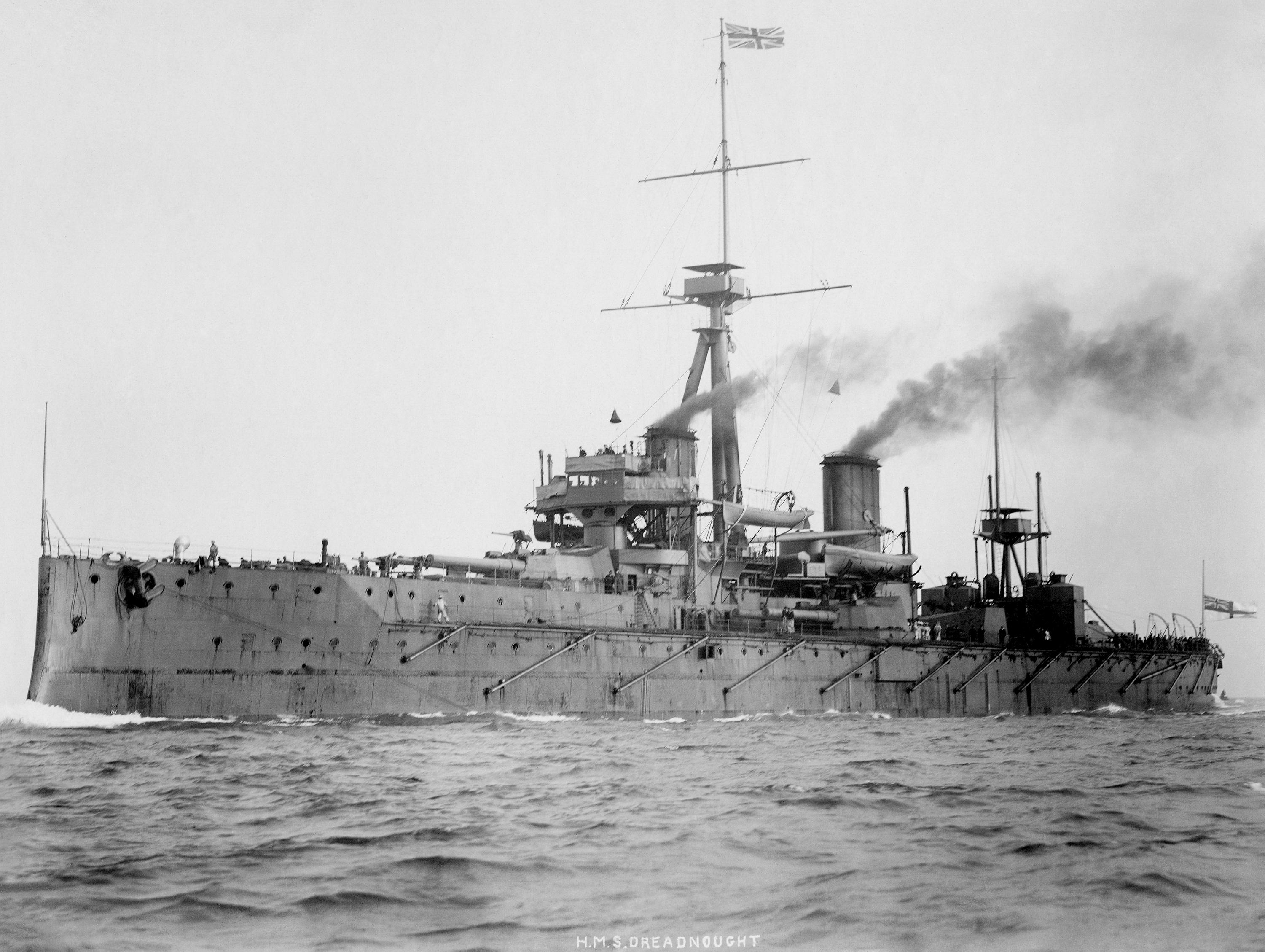
HMS Dreadnought launched in 1906. Ten 12-inch guns where her predecessors carried four. Steam turbines that made her faster than anything else afloat. Built in a year and a day, fourteen months from keel-laying to sea trials, a thing that shouldn’t have been possible, the entire output of British industrial civilisation compressed into a single hull and shoved into the water before anyone else could respond. She was an argument in steel. She was the end of the conversation.
And the moment she touched water, the gradient collapsed.
The important thing is what happened next, not to the Dreadnought but to everything else.
Dreadnought didn’t make other ships worse. The pre-dreadnought battleships in every navy still had the same guns, the same armor, the same range. They were physically identical to what they had been the day before.
But something had changed. In any engagement involving a dreadnought, those older ships would be sunk before they could close to fighting range. The twelve-gun broadside would reduce them to scrap metal while they were still firing at water. the valence of the entire fleet had shifted overnight, not because the substrate changed but because the frame of competition did.
Naval strategists had a term for what happened: they called the older ships “pre-dreadnoughts.” The word itself encoded obsolescence. They weren’t “slightly worse battleships” or “second-tier capital ships.” They were artifacts of a previous era, useful only for coastal defence and colonial gunboat work. The Royal Navy had just spent decades building the world’s largest fleet. Most of it had been rendered worthless in an afternoon.
The math changed. Germany now needed to count only dreadnought-type ships when calculating whether they could challenge British sea power. Britain’s overwhelming numerical superiority vanished. everyone started from zero.
Call it discontinuous utility: the moment when a small improvement in absolute capability creates a categorical break in relative value.
The dreadnoughts never fought. Or they fought once and then never again, which might be worse.
On May 31st, 1916, the British Grand Fleet and the German High Seas Fleet met at Jutland. The largest naval battle in history. Both sides had spent a decade and billions of marks and pounds building dreadnought fleets for exactly this moment.3
The battle lasted twelve hours. Smoke and cordite haze so thick that admirals made descisions by sound alone, by the pitch of salvos landing somewhere they couldn’t see, by the feel of concussion through steel plate. Ships appeared out of the murk and vanished back into it. Whole squadrons lost contact with each other for hours. The British lost more ships. The Germans claimed victory.
And then both fleets sailed home.
That’s it. That’s Jutland. A decade of preparation, the most expensive weapons systems in human history, two fleets that together represented more concentrated destructive power than anything previously assembled, and the result was: both sides sailed home and never fought again.
The German High Seas Fleet spent the rest of the war in port. The British maintained their blockade. The dreadnoughts, those world-historical instruments of discontinuous advantage, sat at anchor, too valuable to risk, rusting gently while the actual naval war was fought by submarines, destroyers, and mines. The battleships that had restructured global strategy became, in practice, a fleet in being: useful only as a threat, never as a weapon.4
The second lesson of discontinuous utility is harder to accept than the first.
The first lesson is that the gradient is an illusion, that second-best options become worthless when the frame shifts. That’s the exciting part. It justifies bold moves, concentrated bets, the willingness to abandon sunk costs.
The second lesson is that even after you’ve built the Dreadnought, you might not get to use it. the discontinuity changes everything except the outcome. Britain and Germany both understood that dreadnoughts had obsoleted all previous naval power. They both built massive fleets. And then they discovered that the new weapons were too valuable to deploy. The frame had shifted, but the new frame was stalemate.
Jutland wasn’t a failure of the dreadnought concept. The ships performed as designed. The discontinuity was real. But discontinuous advantage doesn’t guarantee discontinuous results. sometimes you build the thing that changes everything, and everything stays the same.
The same logic scales down. It also gets stranger, or maybe not stranger so much as more intimate, which is its own kind of strange.
Recruiting operates on a theory of substitutable goods. Apply broadly, maximize the number of offers, choose the best one. The implicit model is continuous: more offers means more options, and more options is always better. The lacuna in this reasoning is that it treats all offers as existing within the same competitive frame.
They don’t.
A mediocre position at a mediocre company isnt 0.7x as valuable as a strong position at a strong company. It’s not even. The relationship between the two isn’t degree, it’s kind, and the difference matters in ways that only become visible years later when the person in the mediocre position realizes they’ve been breathing a particular atmosphere so long they can’t smell it anymore. The mediocre position installs you in a particular ecology: mediocre collegues who normalize mediocre ambitions, mediocre problems that teach you to solve mediocre problems faster, a trajectory whose contours you begin to internalize as the shape of a career rather than the shape of a cage. Your network becomes people who also took mediocre positions. Your resume becomes a narrative legible only within that world, a letter of transit that works at every border except the one you actualy need to cross.
Five mediocre offers don’t compound into one good one. They’re pre-dreadnoughts. They exist on a gradient that has become irrelevant.
The people who understand this treat the search differently. They don’t optimize for offer count. They identify the positions that would represent discontinuous jumps (the teams doing exceptional work, the roles with exceptional scope, the companies where being there at all changes what’s possible) and they focus everything on those. One offer at the right place is worth more than a dozen offers at places that don’t matter.5
The risk, of course, is annihilation. The person who applies only to exceptional positions might end up with nothing at all, staring at an empty inbox in a way that feels less like strategic patience and more like the Baltic Fleet steaming toward Tsushima, fouled hulls and all. The person who applies broadly will probably land somewhere.
But “landing somewhere” is the thing, because it looks like progress and it feels like progress and everyone around you confirms that it is progress, and the slow horror of it is that they’re right, locally. you’re employed. You’re learning something. You’re building experience. All true. All irrelevant if the experience you’re building doesn’t transfer to the game you actually want to play. This is the interstitial space where most careers quietly, not die exactly, but calcify. Not in dramatic failure. in the slow accretion of competance that doesn’t compound, that accretes and accretes into a shape you eventually mistake for the shape you chose.
Standard economic theory models goods as substitutable along smooth curves. If a shirt provides utility U=1.0 and another provides U=0.8, rational agents should wear the inferior shirt some nonzero percentage of the time. Diminishing marginal utility ensures variety. The math is clean, the curves are differentiable, everything behaves.6
This framework assumes the goods are competing in the same game. Which.
Dreadnought didn’t compete with pre-dreadnoughts. She made them irrelevant to the competition that mattered. The pre-dreadnoughts still existed. They still had utility, for certain purposes, in certain contexts. But those purposes weren’t the ones anyone cared about, and the utility function that described their value was a local phenomenon, a description of preferences inside a frame that had just been replaced by a different frame with a different function that couldn’t be reached by any continuous transformation of the first.
Utility functions are local. they describe preferences within a competitive frame. When the frame shifts, the function doesn’t smoothly adjust, it breaks. And the break isn’t something the math handles gracefully, or at all, because the math assumes you can get from any point on the curve to any other point by walking along it, and the whole problem with discontinuous utility is that you can’t. You have to jump. And the math can describe where you were and where you landed but not the moment of being in the air.
In practice this means three things.
First: incumbency is worth less than it looks. The Royal Navy’s fleet of pre-dreadnoughts represented decades of investment and unmatched expertise. None of it translated to the new era. Germany, starting from scratch, could build dreadnoughts just as well as Britain could. The historical advantages evaporated. The same pattern recurs in careers with an almost mechanical regularity, ten years of accumulated expertise rendered inert by a single shift in what the market values.
Second: the transition is faster than you expect. Dreadnought launched in 1906. By 1914, every major navy had dreadnought fleets, and pre-dreadnoughts were afterthoughts. Eight years to completely restructure global naval power. Career transitions can be faster still. a single year at the right company can obsolete a decade at the wrong ones, and the person at the wrong one doesn’t feel the transition happening because from inside the frame everything still looks continuous, the gradient still slopes gently upward, the next promotion still seems like.
Third: recognition lags reality. The German admiralty understood Dreadnought’s implications almost immediately; they had no choice, since their strategy depended on the calculation. But the people who had built pre-dreadnoughts, who had trained to fight in them, who had staked their careers on the old paradigm, they were slower to adjust. Some never did. they kept polishing brass on ships that would never fight again.
The same is true of careers. the person with five mediocre offers sees abundance. The person who understands discontinuous utility sees five positions on a gradient that doesn’t matter.
What Fisher understood, or what I think he understood, though with Fisher you never quite know where the strategic vision ended and the institutional knife-fighting began, was that the second-best option in a discontinuous world isn’t really an alternative. It’s a kind of, not trap exactly, but attractor. A place you settle into because the gradient looks smooth from where you’re standing.
But Jutland understood something too, or rather Jutland demonstrated something that understanding might be too strong a word for. You can build the Dreadnought and still end up in stalemate. The discontinuity is real, but it doesn’t guarantee victory. It doesn’t really guarantee anything except that the old game is over. What replaces it might be better, or worse, or just different in ways you didn’t anticipate. The German fleet sat in harbor for two years after Jutland and then mutinied. The British fleet maintained a blockade that starved a nation. Both outcomes from the same discontinuity. Both unimaginable from inside the old frame.
Build the new thing anyway. Accept that everything you’ve accumulated might be worthless tomorrow. Accept, too, that the new thing might sit at anchor, too valuable to use, while the actual war is fought with submarines and mines.
The cliff is real and the gradient was always an illusion. But what’s on the other side of the cliff, whether it’s Tsushima or Jutland or something else entirely, that you find out after. And “after” is the only part the theory can’t help with.
Footnotes
-
The Baltic Fleet’s voyage is one of the great tragicomedies of naval history. They nearly started a war with Britain, accidentally fired on each other in the dark, stopped in Madagascar long enough for the crews to adopt a variety of exotic animals as mascots, and arrived at Tsushima exhausted, their hulls fouled with tropical growth, the officers half-mad with recrimination. The whole thing reads like a Joseph Conrad novel if Conrad had been less restrained. See Rotem Kowner, Historical Dictionary of the Russo-Japanese War (Scarecrow Press, 2006), and for the broader strategic context, Robert K. Massie, Dreadnought: Britain, Germany, and the Coming of the Great War (Random House, 1991), ch. 21-24. Constantine Pleshakov’s The Tsar’s Last Armada (Basic Books, 2002) tells the voyage itself, and it’s genuinely difficult to believe it happened. ↩
-
Fisher was a strange figure, even by the standards of Victorian admirals. He had pushed for torpedo boats, submarines, destroyers, oil fuel, and all-big-gun ships before any of them were fashionable, and he made enemies at roughly the rate he made reforms. His feud with Lord Charles Beresford nearly tore the Admiralty apart. He also had a habit of dancing with women half his age at naval balls and signing his letters “Yours till hell freezes,” which tells you something about the man that his strategic writings don’t. The standard account remains Arthur Marder, From the Dreadnought to Scapa Flow, 5 vols. (Oxford UP, 1961-1970), vol. 1 especially. ↩
-
Jutland’s legacy is still contested. The British lost 6,094 men and 14 ships; the Germans lost 2,551 men and 11 ships. By tonnage the British losses were roughly double. The Germans called it a victory. The British pointed out that the High Seas Fleet never left port again. Both sides had a point, which is perhaps the most Jutland thing possible. Andrew Gordon, The Rules of the Game: Jutland and British Naval Command (John Murray, 1996) is the essential text on what went wrong and why. Though “what went wrong” might itself be the wrong frame; what if Jutland went exactly right, in the sense that both fleets did precisely what discontinuous logic demanded, which was to engage cautiously, absorb losses they could afford, and retreat before risking the catastrophic engagement that would have settled things? ↩
-
The concept of a “fleet in being” predates the dreadnought era considerably. Mahan discussed it, Corbett theorized it more rigorously. The idea is that a fleet need not fight to exert strategic pressure; its mere existence constrains the enemy’s options. Julian Corbett, Some Principles of Maritime Strategy (Longmans, 1911), remains the clearest articulation. The dreadnought fleet became perhaps the most expensive instantiation of the principle in history. There is something almost theological about building a weapon so powerful that its power is best expressed by never using it, but that’s a different essay, or maybe the same essay read from a different angle. ↩
-
I should note where the naval metaphor frays. Career decisions are iterable in ways that fleet engagements are not. You can recover from a mediocre first job; you cannot recover a battlecruiser from the bottom of the North Sea. The discontinuity I’m describing is real but probabilistic, not deterministic. The analogy captures the shape of the problem, not its severity. Though I sometimes wonder if the iterability is itself partly an illusion, if the person who takes the mediocre job and then tries to jump finds that the window has a way of. ↩
-
The transition from pre-dreadnought to dreadnought took roughly eight years. The transition from horse cavalry to mechanized warfare took roughly fifteen. The transition from mainframe to personal computing, roughly ten. Discontinuous shifts in technology seem to follow a pattern: faster than institutions expect, slower than enthusiasts predict. There might be a generalizable constant in there somewhere, or it might just be a coincidence that flatters the thesis. What interests me more is the phenomenology of the transition from inside it, the way the people living through the shift experience it not as a discontinuity but as a series of small confusions, each one explicable, that only resolve into a pattern afterward. ↩