The Feeling You Can't Verify
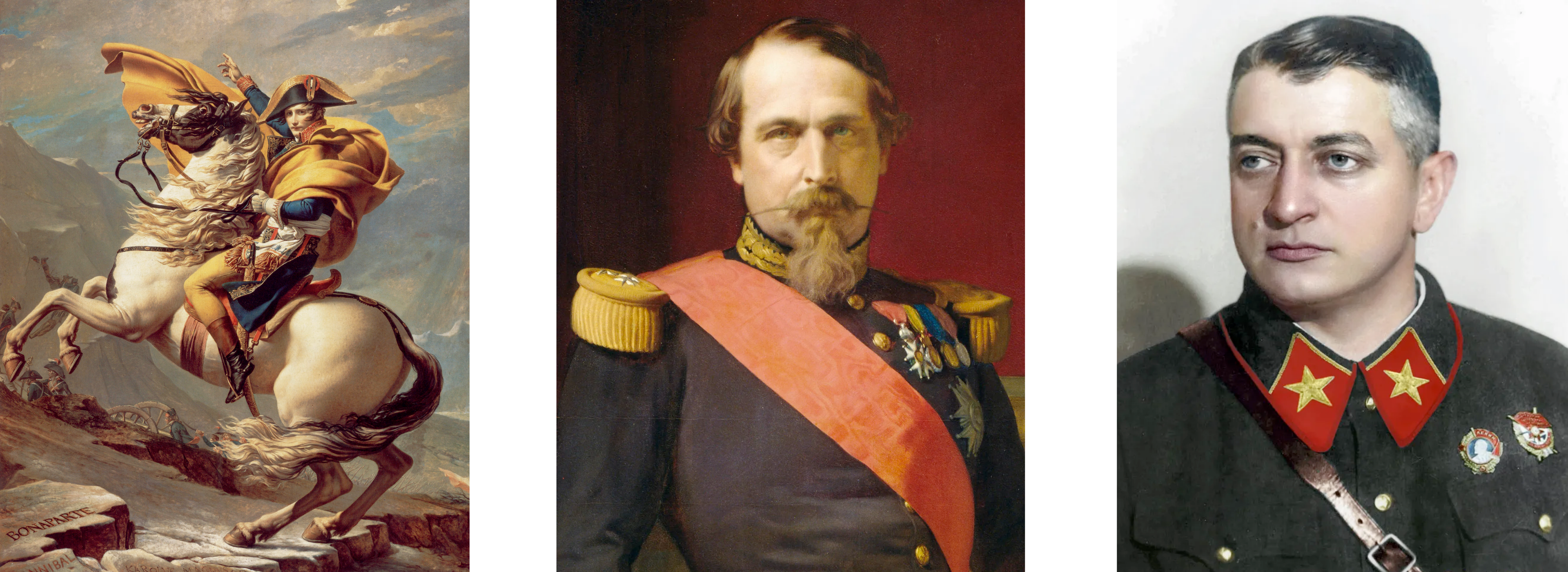
The confession Mikhail Tukhachevsky signed on June 5, 1937 has brown stains on it. The Russian military archives, opened briefly in the 1990s, confirmed what the stains were.1 His signature is legible but not steady. the document runs twenty-one pages and describes a conspiracy with Nazi Germany that did not exist.
He was shot a week later. One of the judges at the tribunal was Semyon Budyonny, a cavalry commander who had spent a decade fighting with Tukhachevsky over whether horses were obsolete.2 Tukhachevsky had said yes. Budyonny had said no. The Wehrmacht, when it came, would settle the argument. Tukhachevsky would not be there to see it.
He had spent the previous fifteen years building the instrument that might have stopped them.
Three cases.
Napoleon I had the feeling and was right. Napoleon III had the feeling and was catastrophically wrong. Tukhachevsky had the feeling, was right about everything that matters, and was shot in a basement anyway.
The third case is the interesting one. Tragedy and farce are at least legible. The third thing, whatever it is, is not.
Start with the nephew, since Marx started there and had reasons.
Louis-Napoleon Bonaparte spent most of his adult life attempting to become what his name said he should be. First attempt: 1836, Strasbourg, a live eagle, because his uncle had used the eagle as imperial symbol and he expected the garrison to recognize the inheritence.3 The eagle did not help. He was arrested within hours and deported to America.
In 1840 he tried again, landing at Boulogne with fifty-six followers and another eagle. The eagle escaped during the landing and was captured by the gendarmerie before the political argument for insurrection could be made. He was arrested, tried, sentenced to perpetual detention in the fortress of Ham.4
He escaped six years later, disguised as a laborer. he walked past the guards carrying a plank.
By 1848, the Revolution had cleared the field. The Second Republic needed a president and had not thought carefully about what name recognition does in plebiscites. Louis-Napoleon won seventy-four percent of the vote. Three years later, he staged a coup against a government he already controlled, declared himself Emperor, held a referendum that approved it by seven and a half million to six hundred forty thousand.5 He ruled for nineteen years.
None of this required genius. It required a name and patience and the particular kind of political instinct that reads a room without understanding why the room is configured that way. He modernized Paris. he built railways. He was baited by Bismarck into declaring a war France could not win, was encircled at Sedan with a hundred thousand soldiers, surrendered personaly to the man who had engineered the whole thing, and died in exile three years later.6 The arc from the escaped eagle to the personal surrender is so perfectly shaped it seems constructed. It wasn’t. It was just what happens when the feeling is inherited rather than earned.
Marx published The Eighteenth Brumaire of Louis Napoleon in 1852, while the ink was still wet. “History repeats itself, first as tragedy, then as farce” — though Marx did not put it quite like that, and the tragedy was specific: the uncle, not some generalized category of failed ambition.7 But the critique went deeper than the joke. Bonapartism, in Marx’s analysis, is the political form that emerges when class conflict reaches stalemate: the bourgeoisie can no longer rule openly, the proletariat cannot yet rule at all, and into the vacuum steps the strongman who seems to transcend faction, to represent the nation itself. He appears to bend the structure to his will. In reality he is the instrument of whoever needed him. the feeling of destiny, in this reading, is the sensation of being useful to forces that have no particular interest in you.
The uncomfortable extension: was Napoleon I any different? The Directory could not stabilize. The bourgeoisie needed an instrument to secure property against the revolution’s own momentum. The Corsican artillery officer who wrote to his brother at twenty-two that he had no fear of death, that he felt himself above personal misfortune, who at that point was a minor officer with no connections and a Corsican accent that marked him as provicial in the one place that mattered — was, from one angle, a man who understood his moment with extraordinary precision.8 From another angle, he was an instrument a class required and discarded when it had what it needed. The feeling is identical in both framings. The inside of it is not distinguishable.
Gramsci tried to split the problem. He distinguished Bonapartism from Caesarism: Caesarism is when a decisive individual resolves a deadlock that neither class can break alone, when the great man is genuinely necessary rather than interchangeable. Bonapartism is the counterfeit, the false resolution that defers the crisis while serving whoever was already dominant. Napoleon I leans toward Caesarism in Gramsci’s reading. His nephew is Bonapartism in its pure form, maintaining an equilibrium so precarious that even this man can hold it, temporarily, until Bismarck decides it’s time.9
the distinction is clarifying and useless at the same time. It does not help from the inside. The uncle and the nephew both had the feeling. One was genius recognizing itself. The other was inheritance mistaken for destiny. From inside: indistinguishable.
Tukhachevsky was born in 1893 to minor Russian nobility, joined the Tsar’s army at twenty-one, and was captured by the Germans within months. He escaped five times from Fort Ingolstadt, that Bavarian fortress the Germans used to hold officers they considred especially likely to try.10 On the fifth attempt he made it.
He joined the Bolsheviks in 1918. At twenty-seven, he commanded an entire front in the Civil War. At twenty-nine, he nearly took Warsaw before his supply lines gave out and the cavalry generals under him ignored orders to wheel north and protect the flank, preferring to chase Lwów.11 piłsudski attacked through the gap. What Poland calls the Miracle on the Vistula is what happened when Tukhachevsky’s operational theory met subordinates who had decided their own objectives mattered more. The postmortem blamed him. Of course it did.
The theory was the thing. Glubokiy boy — deep battle — is the idea that modern mechanized warfare should strike not at the enemy’s front line but at its entire operational depth simultaneously: paralyze the rear, cut the supply lines, prevent reserves from reaching the point of contact, collapse the structure before it can reconsolidate.12 He developed this through the late 1920s and early 1930s, built the tank corps and air force to execute it, was arguing in print for combined-arms mechanized warfare while the German military was still largely a World War I insitution.
The Wehrmacht that came in 1941 used something structurally similar, developed partly in parallel and partly through the secret Reichswehr-Red Army cooperation agreements of the 1920s, when German officers trained at Soviet facilities and Soviet officers attended German exercises, and both sides pretended afterward that the exchange had not been especially informative.13 The Soviet military, by 1941, was using nothing similar. Deep battle doctrine had been officially suppressed after Tukhachevsky’s arrest. It was associated with a traitor. The officers who understood it had been shot or imprisoned. the tanks he built sat in rows and burned.
The purge removed, by most counts, something like thirty-five thousand officers from the Red Army, including three of five marshals, thirteen of fifteen army commanders, fifty of fifty-seven corps commanders.14 Budyonny survived. So did Voroshilov. The military leadership that remained was selected for loyalty, which was the point. The instrament Tukhachevsky spent his life building was handed to people who did not know how to use it, which was also the point.
Zhukov, who eventually turned the war, had trained under Tukhachevsky’s doctrine and held onto it while it was politically unfashionable. The operations at Stalingrad and Kursk used concepts Tukhachevsky had articulated fifteen years earlier. there is an argument, strange and somewhat uncomfortable, that Tukhachevsky did save the Soviet Union, refracted through Zhukov’s memory of what he had been taught, arriving fifteen years late and seven million dead heavier than it needed to be.
Whether this constitutes vindication is a question about what that word requires.
Bismarck spent his late twenties and early thirties running the family estate in Pomerania. He had failed to hold a government job. His mother had wanted better for him and said so repeatedly. He was called the mad Junker for the drinking and the dueling and the apparent directionlessness.15
What he was doing was reading. He had watched the 1848 revolutions sweep through europe and fail, and studied why with the kind of attention that doesn’t announce itself as study. He built a model of how states actually moved: not through principle but through interest, not through ideology but through the material calculations of the people inside the system at any given moment, which is not how most people who want to change the system think about it.
When the moment came — a seat in the Prussian parliament, almost by accident — he was ready in a way that fifteen years of formal credential-building would not have produced. Within a decade he had unified Germany through three precisley calibrated wars.
Napoleon III walked into the Franco-Prussian War because Bismarck edited a telegram. The Ems Dispatch: a diplomatic communication from the Prussian king to the French ambassador, trimmed to remove the softening, to make the exchange appear more curt and insulting to French honor than it was, then released to the press at the moment when French domestic politics made war feel mandatory.16 Bismarck read the edited version aloud to Moltke and Roon at dinner. Moltke, according to Bismarck’s account, straightened in his chair. France declared war on July 19. Bismarck had calculated the declaration, the capablity gap, the outcome, and the territorial consequences, in sequence, before it happened.
Napoleon III had the feeling of being an emperor confronting an insult to French honor. Bismarck had a model of how the system actually worked and where the leverage points were. These are not the same instrument, and the campaigns they produced were not the same war.
From inside Pomerania, preparation and drift look identical. the question of which one you’re doing only resolves later, from the outside, after the moment has come.
The epistemological problem does not resolve.
The feeling is probably necessary: the biographical record does not contain prominent examples of people who accomplished large things without some version of it, or at least not examples that are easy to find. Whether it is sufficient is obviously no. Whether it is even positively corellated with accuracy is genuinely unclear. The uncle and the nephew felt, by all accounts, the same thing. The inside of Tukhachevsky’s certainty, if his writings are any index, looked like theirs.
Marx’s answer is to dissolve the question: the feeling is produced by structural position, expresses class interest, and the individual who feels it is the wrong unit of analysis. This is difficult to refute and also fails to fully account for Bismarck, who changed what was structurally possible rather than merely expressing what the structure required. Or maybe Bismarck was also the instrument of something larger and the model just isn’t fine-grained enough to show it. The Junker class needed a champion. The emerging German industrial bourgeoisie needed unification. The causation runs in several directions at once and doesn’t obviously terminate in the man himself, except that without him specifically, the sequence does not obviously occur — which is either a limit of the Marxist model or an illusion produced by how we construct historical narrative after the fact, and it is not clear which.
People proceed anyway. Which might be the illusion functioning as designed, or might be the only rational response to a situation where waiting for certainty is itself a choice with consequences, or might be both.
Tukhachevsky was forty-four. In that time he had theorized a revolution in warfare, built an army, commanded fronts, shaped a superpower’s defensive capacity. Then the basement, the document, the stains.
Whether that beats a long life in the wrong arena is not a question with a general answer. It might not be a question with an answer at all. It might just be what the options look like from a sufficient distance, which is not the angle from which anyone actually makes the decision.
Footnotes
-
The confession is held in the Russian military archive (RGVA). Volkogonov describes the document in Stalin: Triumph and Tragedy (1991), trans. Harold Shukman. The stains appear on multiple pages. Tukhachevsky was arrested June 5, 1937 and the confession was signed the same day; he was executed June 12. ↩
-
Budyonny had commanded the First Cavalry Army and was among the most politically durable figures in Soviet military life, in large part because Stalin trusted men whose loyalty predated the formal restructuring of the Red Army. He and Tukhachevsky had clashed repeatedly throughout the 1930s over mechanization: Budyonny argued cavalry retained decisive value; Tukhachevsky argued it didn’t. Budyonny signed the death warrant on June 11, 1937. He died in 1973, in his bed, at ninety. ↩
-
The Strasbourg coup, October 30, 1836. Louis-Napoleon had calculated that Napoleonic symbolism would trigger a loyalty reflex in soldiers who remembered or revered the Empire. He was accompanied by a small conspiratorial group and the eagle, which had been trained for the occasion. The garrison was unmoved. He was arrested within hours; the French government, not wanting to give him a trial platform, put him on a ship to New York. ↩
-
The Boulogne landing, August 6, 1840. The eagle was reportedly uncooperative throughout the sea crossing. It was captured by a gendarme during the landing. Louis-Napoleon was tried before the Chamber of Peers and sentenced to détention perpétuelle at the fortress of Ham, in the Somme, which he would escape in 1846 disguised as a workman named Badinguet — a nickname that followed him for the rest of his life. ↩
-
The coup of December 2, 1851, the anniversary of both Napoleon I’s coronation and Austerlitz. The subsequent plebiscite returned 7,439,216 in favor, 640,737 opposed, with approximately 1.5 million abstentions under conditions that were not exactly free. ↩
-
The surrender at Sedan, September 2, 1870. Around 104,000 French soldiers were taken prisoner along with the Emperor. Bismarck met Napoleon III at the Château de Bellevue the following morning. Napoleon III had been suffering from kidney stones throughout the campaign — his staff had known his decision-making was impaired and had not known what to do about it. He died at Chislehurst, Kent, January 9, 1873, during a procedure to break up the stones. ↩
-
The German: “Hegel bemerkt irgendwo, daß alle großen weltgeschichtlichen Tatsachen und Personen sich sozusagen zweimal ereignen. Er hat vergessen, hinzuzufügen: das eine Mal als Tragödie, das andere Mal als Farce.” The “irgendwo” — “somewhere” — is typically dropped in English translation, losing the texture of Marx citing Hegel from memory and knowing he’s doing so loosely. The tragedy in question is the coup of Napoleon I (18 Brumaire, 1799); the farce is his nephew’s coup of December 2, 1851. ↩
-
The letter to Joseph Bonaparte is from Valence, around 1786-1788. The remark about fearing death appears in various forms across Napoleon’s early correspondence; the most commonly cited version dates from around 1793, during the period when he was still proving himself as an artillery officer and had not yet been noticed. ↩
-
The Caesarism/Bonapartism distinction runs through several of the Quaderni del carcere, particularly the notes on Machiavelli and on political parties. The key axis is whether the figure resolves the underlying contradiction between contending classes or merely defers it. Caesarism, for Gramsci, is genuine resolution — the figure is historically necessary. Bonapartism is managed suspension, which is why it always fails eventually; the structural contradiction it was supposed to resolve is still there. ↩
-
Fort Ingolstadt, officially Festung Ingolstadt, held a number of officers the Germans considered high escape risk. Charles de Gaulle was also held there and made multiple unsuccessful escape attempts. Tukhachevsky’s successful escape came in September 1917, crossing through Switzerland; he had used his captivity to learn German and study the facility’s routines. ↩
-
The Battle of Warsaw, August 1920. Tukhachevsky’s Army Group West had advanced rapidly but overextended its supply lines; the southern flank was exposed. He ordered Budyonny’s First Cavalry Army to wheel north. Budyonny and Voroshilov, pursuing Lwów, delayed. Piłsudski attacked the southern gap on August 16. Soviet official history subsequently assigned blame to Tukhachevsky; his own postmortem account, written in 1920, assigned it to the cavalry commanders. Stalin, who had been a political commissar on the southwestern front and backed Budyonny, had reasons to prefer the official version. ↩
-
The key texts are Tukhachevsky’s Новые вопросы войны (New Problems of War, 1932) and his contributions to PU-36, the Red Army Field Regulations of 1936. Vladimir Triandafillov’s The Nature of the Operations of Modern Armies (1929) is theoretically foundational; Tukhachevsky was the institutional force that translated the theory into doctrine and procurement. ↩
-
The Reichswehr-Red Army cooperation, formalized through the Treaty of Rapallo (1922) and subsequent secret agreements, included German tank training at Kazan (the “Kama” facility) and aviation training at Lipetsk, in exchange for industrial assistance. The arrangement ended in 1933 when Hitler came to power. The extent to which shared exercises produced shared doctrine is debated; that there was significant mutual observation is not. ↩
-
Figures from Robert Conquest, The Great Terror (1968, revised 1990), and Oleg Khlevniuk’s subsequent archival research. The specific numbers vary slightly by source and definitional question (executed versus imprisoned versus dismissed), but the directional magnitude is consistent across accounts. ↩
-
“Der tolle Junker” is documented in multiple contemporary accounts and in Bismarck’s own Gedanken und Erinnerungen, where he frames the Pomeranian years with a retrospective calm that arguably understates how directionless they appeared from the outside. His mother Wilhelmine died in 1839, during this period, reportedly disappointed in him. ↩
-
The Ems Dispatch, July 13, 1870. The original telegram reported that King Wilhelm had declined to give the French ambassador a guarantee that the Hohenzollern candidacy for the Spanish throne would never be renewed — a refusal, but a polite one. Bismarck edited out the politeness. He later wrote in his memoirs that when he read the revised version aloud at dinner, Moltke said it would have “the effect of a red rag on the Gallic bull.” France declared war six days later. ↩