Manufactured Enmity and Institutional Paralysis in Tanović's No Man's Land
Two soldiers are stuck in a trench between the lines. One Bosniak, one Serb. A third man is supine on a bouncing mine: if he shifts his weight, the detonation kills everyone in the trench.
The first thing Ciki and Nino do when they realize they’re trapped together is threaten each other. The second thing is share a cigarette. The third is argue about who started the war. Then they help each other. Then they nearly kill each other again. The oscillation is the entire film, and the entire substrate of its argument, hatred functioning only at the level of category, collapsing on contact with the particular the way a doctrine collapses when you try to apply it to someone sitting across from you who is, inconveniently, a person.1
Danis Tanovic’s No Man’s Land (2001) is usually filed as anti-war comedy about the failure of international intervention. It is doing something stranger and more granular than that: testing what happens when groupthink meets the individual organism, the wet fact of a particular body in a particular trench. Ciki and Nino cannot sustain their enmity face to face. They keep defaulting to being normal with each other, to cigarettes and gossip and shared reference, to the gravitational pull of someone who speaks your language and knows your streets. The hatred only operates at a distance, in the penumbra of “Serbs” and “Bosniaks” as categorical abstractions. In the interstitial space of the trench, they are just two men who speak the same language and know the same people.
The Same Country
The division was recent. Not ancient enemies from separate civilizations. Yugoslavia was a functioning multinational state with genuine integration. Intermarriage rates in Bosnia were substantial, particularly in urban centers.2 The 1984 Winter Olympics were held in Sarajevo. Eight years before the siege. The Yugoslav People’s Army, the JNA, was deliberately multi-ethnic in design: officers rotated across republics, units mixed nationalities, the entire institutional architecture engineered to prevent exactly the fracture that consumed it.
Ciki and Nino are the residue of that integration. They speak the same language. They share the same cultural substrate. There is a moment where they realize they almost certainly know the same girl. The trench between them is a recent lacuna cut into continuous territory, a wound so new you can still see the soil it displaced. Everything else about them is shared.
The mine under Cera is a PROM-1.3 Yugoslav manufacture. Bounding fragmentation mine, spring-loaded ejection to roughly one meter altitude before detonation, shrapnel dispersal at chest height across a lethal radius of several meters. A steel seed planted by the country all three of them used to share, now germinating in the body of one of its citizens. The device does not know which side it serves because there were no sides when it was manufactured. The valence of the object has shifted without the object changing at all, which is maybe the purest diagram of what happened to everything in Yugoslavia, the roads and the schools and the apartment blocks all remaining physically identical while becoming, overnight, enemy infrastructure.
Manufactured Enmity
The standard narrative about the Bosnian War involves “ancient hatreds” boiling over after Tito’s death. The scholarship does not support this. Or rather, the hatreds were ancient and also functionally inoperable for decades, held in suspension by intermarriage, mixed neighborhoods, shared institutions, the ordinary machinery of coexistence.4 What changed was not that people remembered they hated each other. What changed was that the hatred was deliberately reactivated from above, instrumentalized by political actors who needed ethnic mobilization to consolidate power, who reached into the sediment of history and pulled out something they could sharpen into a tool.
The violence was organized. Paramilitary formations like Arkan’s Tigers, the Serb Volunteer Guard, were deployed into mixed communities with specific operational objectives, not to win battles (that was almost secondary), but to make coexistence structurally impossible. Burn several houses in a mixed village. The remaining residents flee or are expelled. The community that existed there is annihilated as a social fact, unmade so thoroughly that even the possibility of its reconstruction evaporates, the people scattered across refugee camps in Germany and Sweden and Turkey, the social tissue not damaged but dissolved. You cannot put dissolved tissue back together. The project, and it was a project with engineers and budgets and supply chains and men who went home to dinner afterwards, was irreversibility.
This is what the film captures without ever stating it. The groupthink required for the war to function had to be manufactured because people like Ciki and Nino were not naturally inclined to kill each other. Left alone in a trench, stripped of institutional scaffolding, they share cigarettes and argue about girls. The categories “Bosniak” and “Serb” only produce violence when embedded in an apparatus: armies, paramilitaries, propaganda infrastructure, chain of command, the whole grinding mechanism of mobilization. The trench dissolves that apparatus. What remains is two people who have far more in common than not. Which is, of course, precisely the condition the war was designed to destroy.
Milosevic needed paramilitaries precisely because ordinary conscripts would not do it unprompted. That is what the “ancient hatreds” narrative obscures, perhaps intentionally: the hatred was a project. It had engineers and budgets and logistics. It had men who sat in offices and planned things and the planning is what made it work, not the eruption, the eruption was the cover story for the planning, and the distinction between those two things matters more than most commentary on the Balkans has been willing to sit with.
The Observers
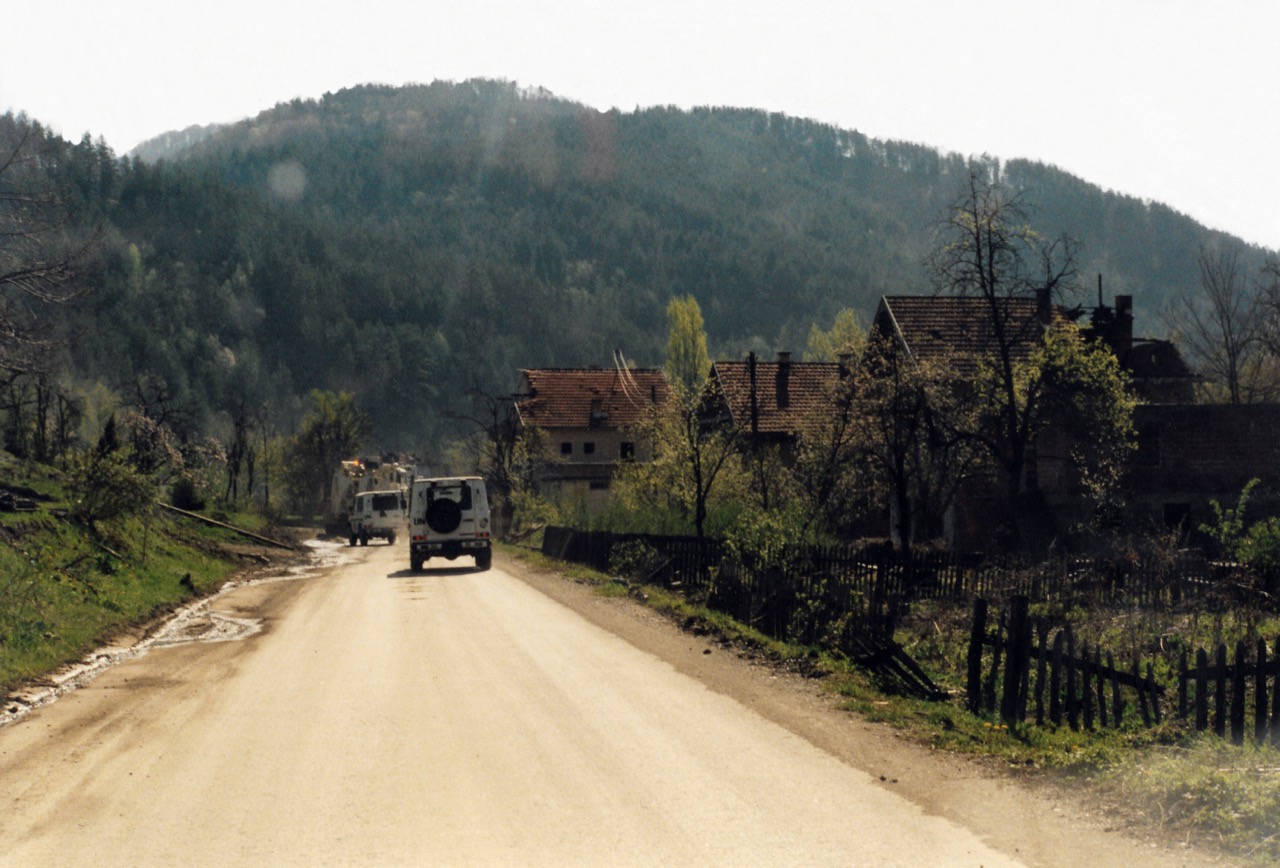
Then there is everyone outside the trench.
The UN peacekeepers want to help but need authorization. The commander wants to avoid an incident. The journalist broadcasts the situation, which forces action, which produces a circus, which resolves nothing. Each successive layer of observer deposits another stratum of paralysis, one atop the next, compressing into something almost geological: sedimentary dysfunction, the institutional record of many small refusals fossilized into permanent inaction.
Sergeant Marchand, the French peacekeeper, is the only figure who attempts to act as though the situation is what it obviously is: a man lying on a mine. He drives to the trench. He talks to the soldiers. He calls for a bomb disposal team. At every step his chain of command arrests his momentum, the mandate does not cover this, pull back, the mandate does not cover anything that would actually help. The gap between perception and authorization, between seeing a man on a mine and being permitted to do something about the man on the mine, that gap is where the film’s comedy lives and where its fury concentrates, and if you have ever watched a committee discuss whether a drowning person falls within the scope of their… you know the gap, you have stood inside it.5
The bureaucratic language is absurd because the situation is absurd, but the absurdity has a particular texture, almost medical in its sterile refusal to acknowledge the bleeding. A man is lying on a mine and the institutional response is to check the mandate. UNPROFOR’s actual mandate was itself a kind of organized hallucination. “Safe areas” that lacked defensive infrastructure. Protection forces stripped of the authority to use force. The words meant something other than what the words meant. Srebrenica was a UN-designated safe area. Dutch peacekeepers of Dutchbat III were present when Mladic’s forces arrived in July 1995. They requested air support. It was denied, then delayed, then denied again, the requests cycling through a chain of command that seemed to exist specifically to metabolize urgency into procedure, to convert the intolerable into the merely administrative. 8,000 men and boys were killed in the days that followed. Separated from their families at a UN compound. The peacekeepers watched.
The comedy, and it is comedy, lands because everyone on screen can see what is happening, every single person, and the space between seeing it and being authorized to do anything about it is not a gap so much as a… it is the architecture itself. The architecture is the gap.
The Trench as the War in Miniature
What Tanovic achieves is the compression of the entire conflict’s architecture into a single location, and that compression is why the film operates at a frequency most anti-war cinema cannot reach. The trench contains everything.
The shared humanity that had to be erased for the war to happen: Ciki and Nino defaulting to normality with each other. The manufactured enmity that keeps reasserting itself: they pick up their guns again, because the war persists as a structural condition even when its justifications dissolve on contact. The Yugoslav infrastructure that became the mechanism of its own annihilation: the PROM-1 under Cera, state-manufactured ordnance deployed against the state’s own citizens. And the international community, which watches, documents, and leaves.
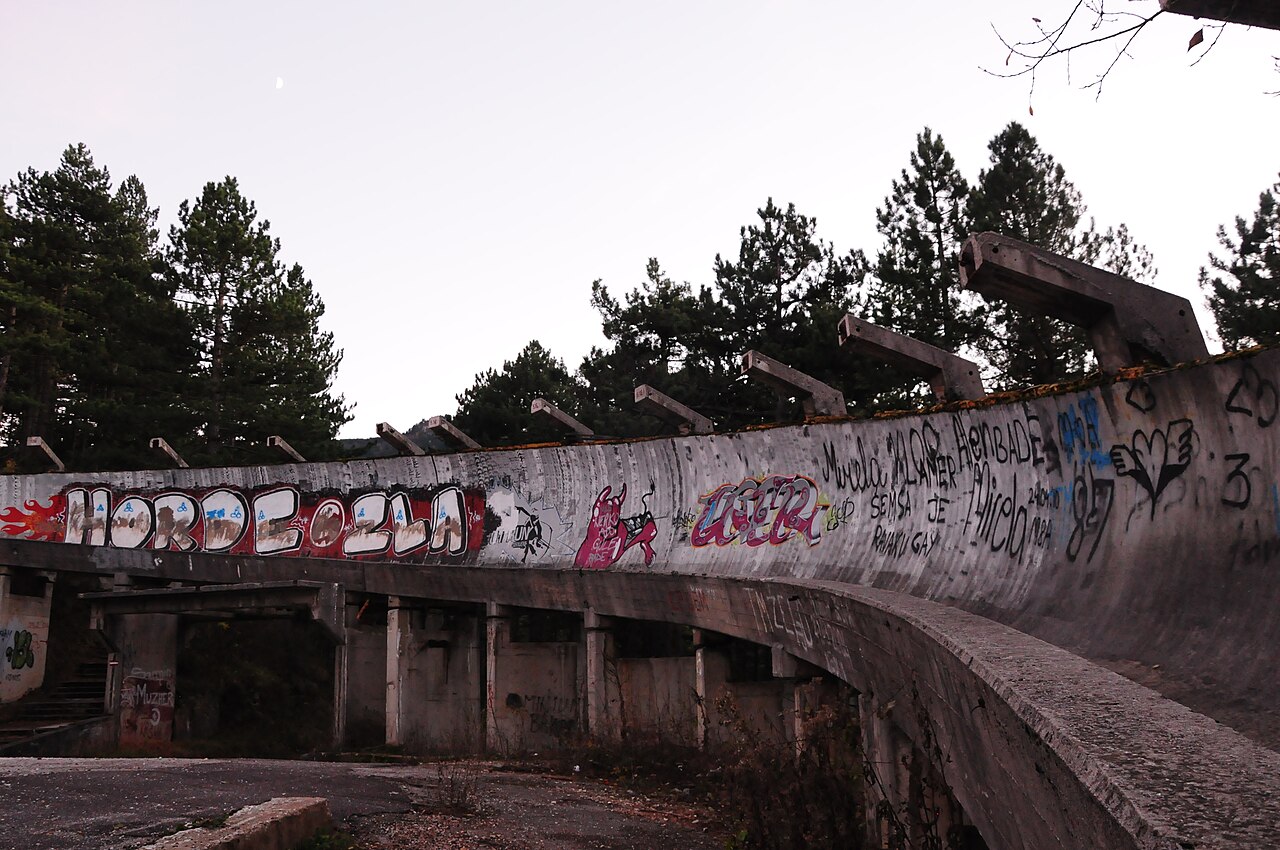
The bobsled track from the 1984 Sarajevo Olympics was converted to an artillery position during the siege.6 A concrete chute engineered for velocity and spectacle, a beautiful useless tube snaking down a mountain, and then repurposed for shelling the city it was built to celebrate. The two objects belong next to each other, the bobsled track and the PROM-1. A country builds an Olympic venue and a bounding fragmentation mine. Eight years later, one is used to kill the people who cheered at the other. The symmetry is almost too neat. Almost. But that neatness is the problem, or the condition, or whatever word you want for the fact that the same industrial base that produced the celebration also produced the ordnance, and the distance between those two products was always shorter than anyone wanted to think about.
The Last Shot
The UN declares the situation resolved. The bomb disposal expert determines the mine cannot be defused. Everyone leaves. The cameras leave. The soldiers leave. Cera is left alone in the trench, on the mine, alive, and the film holds on him in a wide shot that becomes uncomfortable and then keeps holding, long past where you expect the cut, past where the cut would let you off.
Tanovic served in the Bosnian Army. He shot documentary footage during the siege of Sarajevo. He has seen what it looks like when institutions determine that a problem is unsolvable and withdraw. The knowledge is structural in the film, not decorative.
The Dayton Agreement ended the war by freezing the ethnic cleansing in place. The Republika Srpska, the entity created through genocide and mass displacement, was recognized as a constituent part of Bosnia and Herzegovina. Karadzic was not arrested until 2008. Mladic until 2011. The temporal gap between the crime and the consequence is its own kind of trench, I think, a space where something unresolved just persists, and the persistence is not dramatic, it is bureaucratic, which is worse.
The situation was declared resolved. The cameras left. And Cera is still on the mine, which is not a metaphor you arrive at so much as one that arrives at you and then does not leave, because that is what the film understands about institutional abandonment: it is not an event, it is a condition, and the condition outlasts every declaration of resolution that gets layered on top of it.
Footnotes
-
Tanovic’s first feature film. It won the Academy Award for Best Foreign Language Film at the 74th Academy Awards ceremony in March 2002, beating Jean-Pierre Jeunet’s Amelie (which had been the heavy favorite). Also won the Best Screenplay award at Cannes. For a debut by a Bosnian director working with a fraction of the budget, this was not a minor upset. There is something fitting about a film about being ignored winning the award nobody expected it to win, though I am maybe reading too much structural irony into an awards ceremony, which is itself a kind of institutional performance of… anyway. ↩
-
Intermarriage rates in pre-war Bosnia, particularly in Sarajevo, were among the highest in Yugoslavia. Robert Donia and John Fine’s Bosnia and Herzegovina: A Tradition Betrayed (Columbia University Press, 1994) documents the extent of interethnic social integration, noting that by the 1980s roughly a quarter to a third of marriages in urban centers were mixed. The numbers vary across sources. The consistency of the finding does not. Ethnic categories in Sarajevo functioned as something closer to background noise than to the rigid identity structures the war would impose, or require. ↩
-
The PROM-1 (Protivpesadijska Odskocna Mina) was JNA standard issue, a bounding fragmentation mine with a tripwire or pressure-release fuze. Spring-loaded steel body, ejection charge launches the mine to approximately 0.5 to 1.5 meters before the main charge detonates, distributing steel fragments in a roughly spherical pattern. Lethal radius of about three to four meters, casualty radius considerably larger. The grim irony, which the film registers without commentary: all sides in the Bosnian War used JNA equipment because all sides were, organizationally, fragments of the same army. The weapons did not need to be imported. They were already distributed. Something almost domestic about that, killing your neighbors with shared kitchen knives. ↩
-
The “ancient hatreds” thesis was influentially advanced by Robert Kaplan’s Balkan Ghosts (St. Martin’s Press, 1993), which reportedly shaped Clinton-era reluctance to intervene. Subsequent scholarship has largely dismantled the framing. Samantha Power’s A Problem from Hell: America and the Age of Genocide (Basic Books, 2002) provides a comprehensive account of the international response, or non-response, to the Bosnian War within the broader pattern of American inaction during genocide. David Rieff’s Slaughterhouse: Bosnia and the Failure of the West (Simon & Schuster, 1995) is angrier, more visceral, written from inside the siege. Less analytical distance, more texture. Both are essential, they do different things. Reading them back to back produces a kind of stereoscopic effect where you can see the same events from two focal lengths simultaneously, which is disorienting, which is probably the point. ↩
-
The UNPROFOR mandate is one of those documents that reads like satire in retrospect. Security Council Resolution 836 (1993) authorized peacekeepers to “deter attacks” on safe areas but the rules of engagement were so restrictive that deterrence was effectively theoretical. Marchand’s frustration in the film is not exaggerated. If anything it is restrained. The institutional architecture was designed to produce the appearance of protection without the substance. Which is, when the object of non-protection is a civilian population, not just bureaucratic failure but something closer to, I don’t know, structural cruelty wearing a blue helmet. ↩
-
The bobsled and luge track on Mount Trebevic, designed by Slovenian architect Vlado Ruzdjak for the 1984 Winter Olympics, is still partially standing. Overgrown, covered in graffiti, sections crumbling. During the siege of Sarajevo (1992-1996), its elevation and concrete construction made it useful as a firing position for Bosnian Serb forces shelling the city below. Compare Tanovic’s approach to Emir Kusturica’s Underground (1995), which deploys similar absurdist comedy to address Yugoslav disintegration but with murkier political commitments. Kusturica’s film is more mythological, more sprawling, more interested in the carnivalesque. Tanovic is more precise about who failed and how, the comedy sharpened to a finer point. The comparison is instructive but I am not sure it is symmetrical. ↩