In the Heat of the Sun: Memory as Authorship
The film opens on a Beijing summer in the 1970s, during the Cultural Revolution. A teenage boy named Ma Xiaojun runs wild through empty streets with his friends. Their parents are gone, absorbed in political campaigns. The city has become a playground with no adults to supervise.
There’s a girl, Milan. Older, beautiful, unattainable. Ma Xiaojun breaks into her apartment when she’s not home and lies on her bed. He steals her photograph. He inserts himself into her life by sheer force of will. She may or may not notice him. The film is hazy on this. The light is always golden. Every scene looks like a memory that’s been polished by decades of longing.
Two hours later, near the end, Ma Xiaojun confesses: “I made it all up.”
I watched him confess and felt caught.
There’s a thought experiment I keep returning to. If you replace every plank of a ship, one at a time, is it still the same ship? The answer is obviously no, and obviously yes, and the question is designed to make you uncomfortable with both.
I think about this with people. With myself. The cells in your body replace themselves. Your brain rewires. The person who lived through your childhood is connected to you by an unbroken chain of days, but that’s it. You share a name. You share a body, sort of. You share memories.
Except you don’t, really. You share the memories you’ve kept. The ones you’ve rehearsed, revised, selected. The others are gone. The person who lived them is gone too, in every way that matters except the story you’ve built from the wreckage.
Ma Xiaojun understands this. Or rather, the film understands it about him. The summer he shows us isn’t recovered. It’s authored.
Memory isn’t a recording. I know this intellectually, but the film made me feel it. Every time you remember something, you’re reconstructing it from fragments. The brain fills in gaps with plausible details. Each recall is a new act of creation. The memory of the memory replaces the memory of the event, and so on, until what you’re remembering is just the most recent reconstruction.
This means the things you remember most vividly are often the least accurate. You’ve handled them too many times. They’ve been worn smooth by repetition, polished into the version that fits best. The memories you never think about might be closer to what happened, but they’re also fading, inaccessible, half-gone.
Ma Xiaojun has thought about Milan for decades. He’s told himself the story of that summer so many times that the story is all that remains. The film makes this visible. The golden light isn’t how Beijing looked. It’s how he needed it to look. Milan in slow motion, backlit, turning toward him. That’s not memory. That’s desire fossilized into fact.
I think about my own most vivid memories. The ones that feel solid and true. And I wonder how many times I’ve revised them without noticing.
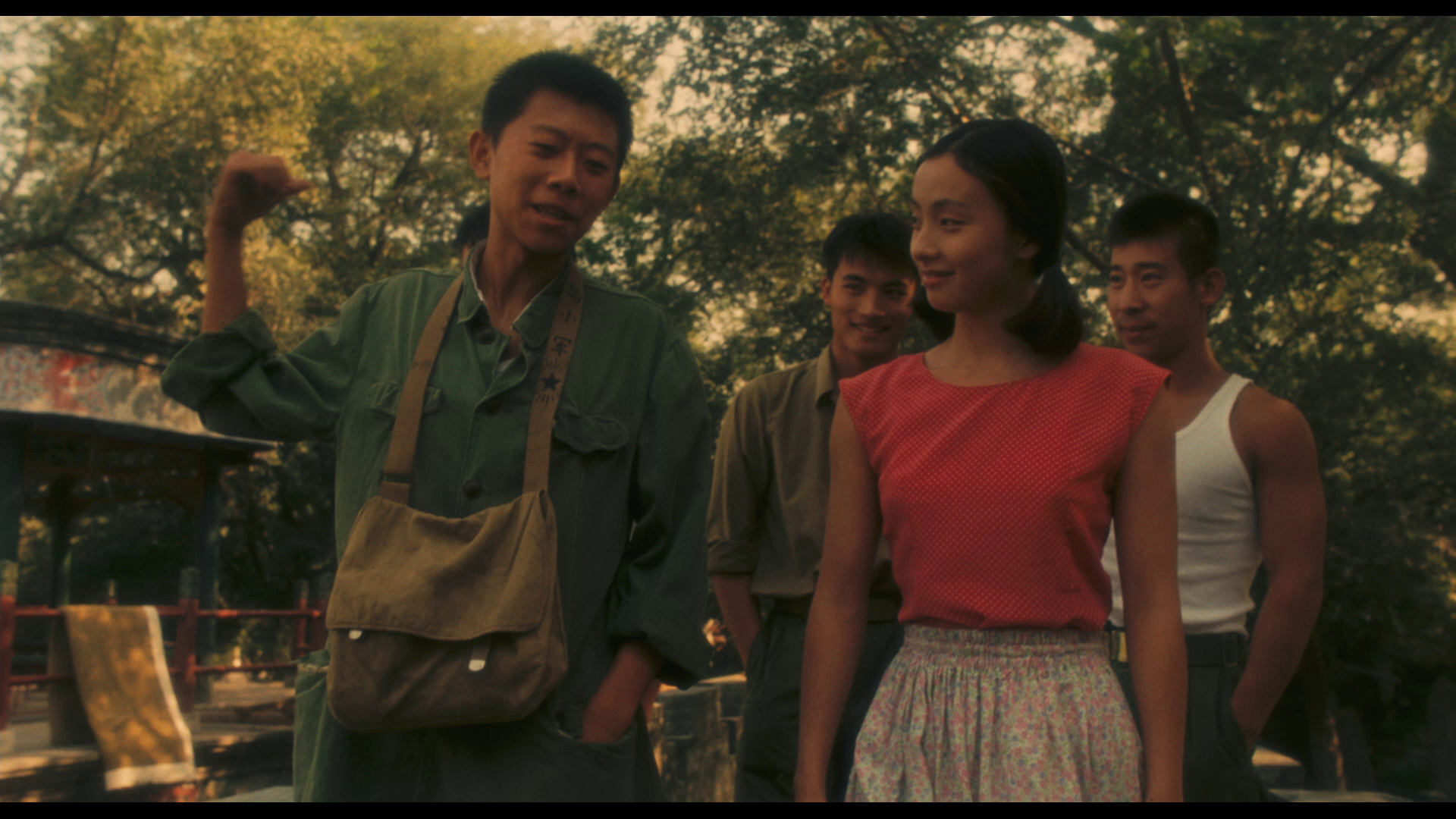
The Cultural Revolution is important to the film, though it barely appears directly. The parents are gone, absorbed in struggle sessions and denunciations. The adults have their own mythology to construct. No one is watching the children.
This matters because there’s no one to contradict them. No one to say “that’s not how it happened” or “you weren’t that brave” or “she didn’t look at you that way.” The kids are building their reality in real-time, collaboratively, and memory will rebuild it again later. Each reconstruction a little more coherent, a little more flattering, a little further from whatever actually occurred.
I think about how much of childhood works this way. You’re too young to have reliable witnesses. Your parents remember a different version, focused on different details, and anyway they weren’t there for most of it. Your friends remember their own versions, centered on themselves. By the time you’re old enough to compare notes, the stories have already hardened. The mythology is load-bearing. You’ve built a self on top of it.
Who would I be if I remembered my childhood accurately? I can’t even formulate the question properly, because I don’t know what accurately would mean. Accurate to what? The experience I had at the time? The experience I constructed afterward? The experience I’ve reconstructed every time I’ve thought about it since?
There is no master copy. There’s just the latest draft.
Here’s what the film made me wonder: how much of my past have I selectively authored?
Not lied about. That’s too crude. Ma Xiaojun isn’t lying, exactly. He’s doing something more subtle and more universal. He’s chosen what to remember. He’s chosen what it means. He’s arranged the fragments into a narrative that explains who he became.
I do this. You do this. Everyone does this. It’s not optional.
Think about the stories you tell about yourself. The origin myths. “I was always interested in X.” “That summer changed everything.” “I knew then that I wanted to Y.” These aren’t neutral reports. They’re selections. Out of the chaos of lived experience, you’ve picked certain moments and declared them significant. You’ve drawn lines connecting them. You’ve made them into a story with a protagonist and an arc.
The moments you didn’t select have faded. They’re not part of the narrative, so you don’t rehearse them, so they decay. The story becomes more true over time, not because it matches what happened, but because what happened is disappearing while the story remains.
Ma Xiaojun needed to be the protagonist of that summer. He needed Milan to have seen him. He needed his courage to have been real. So when he reconstructed the past, he made it so. Not consciously. Not deceptively. Just inevitably. The alternative would be to carry a fragmented, incoherent, meaningless jumble of sensory data. No one can do that. No one should.
I think about the stories I tell about myself. The ones I’ve told so many times they’ve smoothed into fact. The version of my childhood that makes sense. The moments I’ve selected to mean something.
How much did I shape to fit? How much did I invent?
I don’t know. I can’t know. That’s the uncomfortable part.
But here’s the thing: I’m not sure it’s bad.
The film doesn’t judge Ma Xiaojun. It treats his fabrication as inevitable, maybe necessary. The confession at the end isn’t a moment of shame. It’s almost a shrug. Of course he made it up. What else was he supposed to do?
You can’t carry a fragmented past. You can’t walk around with unprocessed chaos where your history should be. You have to make it into a story. And stories have protagonists, and arcs, and meaning. Stories have coherence. Life doesn’t, but the memory of life can, if you work at it, if you select carefully, if you’re willing to let the inconvenient parts fade.
I don’t think there’s an authentic version. There’s just the version you’ve built, and the version you’re building now, and the version you’ll build next time you remember.
The fabricated memory shaped Ma Xiaojun. The summer he invented made him who he is. The golden light, the perfect girl, the brave version of himself. He became the person who had that summer, even though he didn’t have it. The memory was load-bearing. It held up a self.
I think my memories work the same way. The versions I’ve constructed aren’t corruptions of some purer truth. They’re the material I’ve used to build a person. Take them away and there’s nothing underneath. Just fragments that never cohered. Just data that never became a self.
The final scene shows the grown characters in a limousine, nouveau riche in the new China. Money, status, the markers of having made it.
The color drains to black and white.
They don’t recognize each other. They don’t recognize themselves. The golden summer is so far away it might as well have happened to different people. Which, in a sense, it did. And also didn’t.
Ma Xiaojun’s voiceover is detached, almost clinical. The warmth is gone. The nostalgia has curdled into something else. He looks at these middle-aged strangers and tries to connect them to the kids on the rooftops, the kids in the golden light, and he can’t quite do it.
Maybe they never knew each other. Maybe no one ever knows anyone. Maybe the versions we construct of other people are as fictional as the versions we construct of ourselves.
I don’t know what to do with this. The film doesn’t offer a solution, just a recognition.
We are the stories we tell about ourselves. The stories are not true, not in the way we usually mean true. But they’re not false either. They’re something else. They’re functional. They’re load-bearing. They hold up a self that would collapse without them.
Ma Xiaojun made up his golden summer. He confesses this, and then the film ends, and we’re left to wonder what we’ve made up about ourselves.
I don’t have an answer. I just have the question now, and it won’t go away.
What did I make up? What am I making up right now, in the act of remembering? What version of myself am I constructing as I write this, selecting these thoughts, arranging them into a narrative, making them cohere?
Is that even a bad thing?
I don’t think so anymore. I think it’s just what we do. I think it’s the only thing we can do.
The truth is probably messier. Duller. Less golden. And anyway, it’s gone. All that remains is the story.
Might as well make it a good one.